Why Generic AI Meeting Summaries Are Failing Your Team
I used to rotate who took the notes.
The logic seemed fair. The same people always ended up doing the administrative work while others were comfortable in long discussions. So I started assigning it to people who did not usually do it.
What I did not anticipate was what that rotation revealed. The problem was never the quality of the notes. It was that nobody in the room, including the person holding the pen, believed the notes mattered. Documentation was treated as a black spot. Something that needed to exist so the meeting felt complete, not something that carried any real weight in what happened afterward. The people I assigned to it did not resist because they were lazy. They resisted because the role had no dignity attached to it. It was perceived as administration, not contribution. And when you assign someone a role that the whole room silently agrees is beneath the real work, you get exactly the level of care that perception produces.
What I was watching was not a skill problem. It was an integrity gap in the process itself. Nobody felt accountable for transferring the context of that meeting into something the people who were not there could act on. The notes existed. The context did not make it out of the room.
That observation stayed with me for years. And it became one of the things that convinced me generic AI summary tools were solving the wrong problem in the wrong way.

The Mirror Problem
Before I understood what was wrong with meeting documentation, I thought I understood whether people had grasped what was needed.
For a long time, I believed that if I left a room and someone could give me back a summary of what they needed to do, they had understood it. That was a trap. The more people I led, the more I encountered individuals who had learned, consciously or not, to mirror. To reframe my words back at me. To match my tone so precisely that I left the conversation feeling that everything was clear.
It was not clear. The words were right. The mutual context was not there.
The only way I found to close that gap was to be fully present in the room. Not reviewing notes afterward. Not reading a summary. Facing the person, watching how they held the material, feeling with every social signal available whether they actually had it or were performing understanding.
That is not a scalable approach. And it should not need to be. But it tells you something important about what a meeting summary is actually supposed to do.
A summary is not a transcript. It is not a list of what was said. It is a transfer of context. The what, the how, the why and how to follow up. And of those three, the what is almost always captured. The how and the why are almost always lost.
Why Generic AI Output Makes This Worse
When I first looked at what AI meeting tools were producing, my immediate reaction was that the output looked correct. Sentences were formed properly. Action items were present. The summary read like a competent human had been in the room. Until I read a sentence carefully. Then another. Then I started noticing what I had noticed in people who mirror well: the words were right, but the understanding behind them was absent.
A generic AI summary is trained to produce something that looks like a meeting summary. It is not trained to understand your meeting type, your team's terminology, your decision-making logic, or the specific context that made this meeting different from the last one on the same topic.
The result is output that is formally correct and contextually thin. It captures the what and produces a plausible version of the how and why based on generic patterns. For a straightforward meeting with simple, isolated tasks, it holds. For anything with dependencies, constraints, competing priorities, or nuance, it gives you back something that sounds right until you try to act on it.
What Do Summary Customizations Mean for Minuteory
When I started thinking about how Minuteory should produce summaries, the easy answer was to build one excellent template and apply it to everything. I have used enough tools that did exactly that to know it does not work. The word customization in software tends to mean color themes and field labels. In the context of meeting summaries, it means something more fundamental: building a system that learns how your organization actually works until the output it produces could only have come from you.
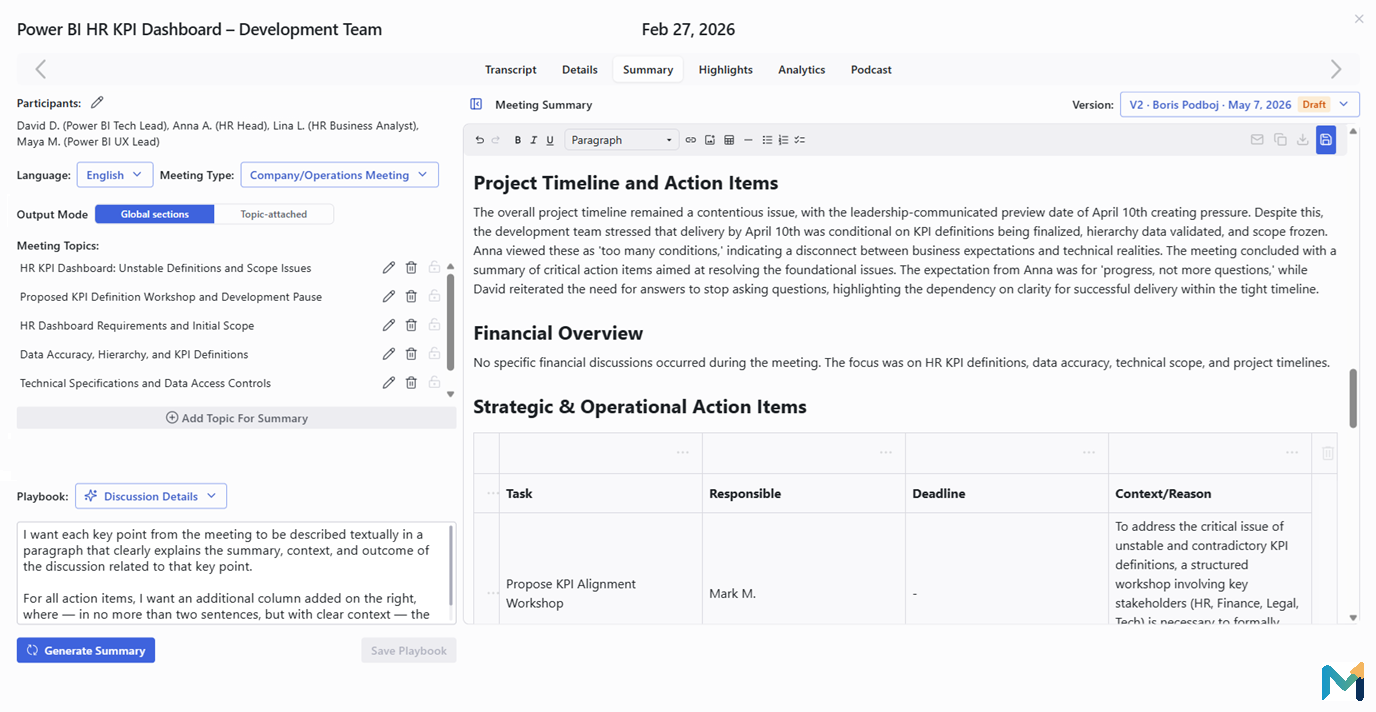
Imagine you run three types of meetings every week. A standup, a client delivery review, and a monthly retrospective. The first time you set up Minuteory, you create a Playbook for each one. The standup Playbook tells the AI to look for blockers and commitments and nothing else. The client call Playbook tells it to track decisions and named next steps with ownership explicit in every line. The retrospective Playbook tells it to surface what was agreed, who accepted which action, and what needs to change in the next cycle. You write each instruction once in plain language, the same way you would brief a sharp new team member on what matters in each room. From that point on, every meeting of that type runs through its Playbook automatically.
And the instruction can go further than structure. If your team responds better to a creative closing than a formal summary, you can tell the Playbook to generate a short haiku at the end of every meeting summary based on the topics discussed that day. It sounds like a small thing. In practice it is the difference between a document people open once and file away, and one they actually read. Whatever makes the output connectable for your team is a valid instruction. The Playbook does not judge what good output looks like. Your organization does.
Then something subtler starts to happen. You read a summary and notice the AI used a term your team does not use internally. You correct it. You do this a few more times across a few more meetings. Minuteory logs every edit. Over weeks it begins to learn your business domain, your terminology, the way your team refers to specific processes and roles. The summaries stop sounding like they were written by someone who sat in on your meetings once. They start sounding like someone who has been in the room for months.
As your organization grows and the meeting types multiply, you add new ones. A partner onboarding session. A board update. A workshop format that does not fit any standard category. Each new type gets its own logic, its own extraction structure, its own definition of what a good output looks like. If your workshops always start with a predefined agenda, that structure feeds in before the meeting begins. The AI is not discovering the format after the fact. It knows what it is looking for before anyone has said a word.
What you end up with is not a summary tool configured to your preferences. It is a documentation layer shaped by your organization, your language, your meeting types, and your process. Whatever combination of those elements works for how your teams actually run is what the system learns to produce consistently, without anyone needing to manage it meeting by meeting.
The Test That Reveals the Gap
Take a summary from your last important meeting. One where real decisions were made and real commitments given. Do not give it to someone outside the business. Give it to a colleague who was not in that specific meeting but knows your domain, your terminology, and your processes well enough to work with them.
Ask them one question. Based on this summary alone, could you explain to the next person why we made this decision and not the alternative?
If they hesitate, or if they can name the what but not the reasoning behind it, the summary has not transferred the context. It has produced a record that satisfies the administrative need but does not carry the meeting's actual output forward into the next conversation, the next decision, or the work of the person who was not in the room.
That is the gap generic AI tools are not closing. They are producing better-formatted versions of the same thin documentation that teams have always struggled with. The colleague who was not there still cannot explain the why. The person inheriting the task still does not know why this approach and not another. The decision that was made with full context in the room arrives downstream as a directive without a rationale attached.
If your meetings produce real decisions and real commitments that need to survive contact with the work that follows, start at app.minuteory.com and see what a summary looks like when it is built for the meeting that created it.