
The Real Cost of Writing Meeting Minutes by Hand
The hour is easy to see. Someone sits down after the meeting, opens a document, and writes up what happened. Thirty minutes if they are fast. An hour if the meeting was long and complex. Multiply that across every meeting your team runs in a week and the number is already uncomfortable.
But that is not the real cost. The real cost starts the moment those minutes are finished.
What Actually Gets Written

I spent years watching how meeting notes got made across different teams and organisations. The pattern was almost universal.
The person writing the minutes was not a neutral recorder. They were a participant who had their own role in the meeting, their own view of what mattered, and their own interpretation of what was decided. By the time they sat down to write, twenty minutes had passed and the conversation was already compressing in their memory into a version that fit their understanding of it.
The result was a document that captured the meeting as one person understood it, not as it actually happened. Key decisions were summarised in ways that left room for later disagreement. Action items were recorded in language that sounded specific but was not: "team to revisit", "follow up required", "discuss further in next session." Names were sometimes attached and sometimes not. Deadlines rarely appeared.
This is not a criticism of the people writing the notes. It is a description of what manual note-taking produces under realistic conditions. The cognitive load of participating in a meeting and documenting it simultaneously is too high for either task to be done well.
The Compounding Costs Nobody Calculates
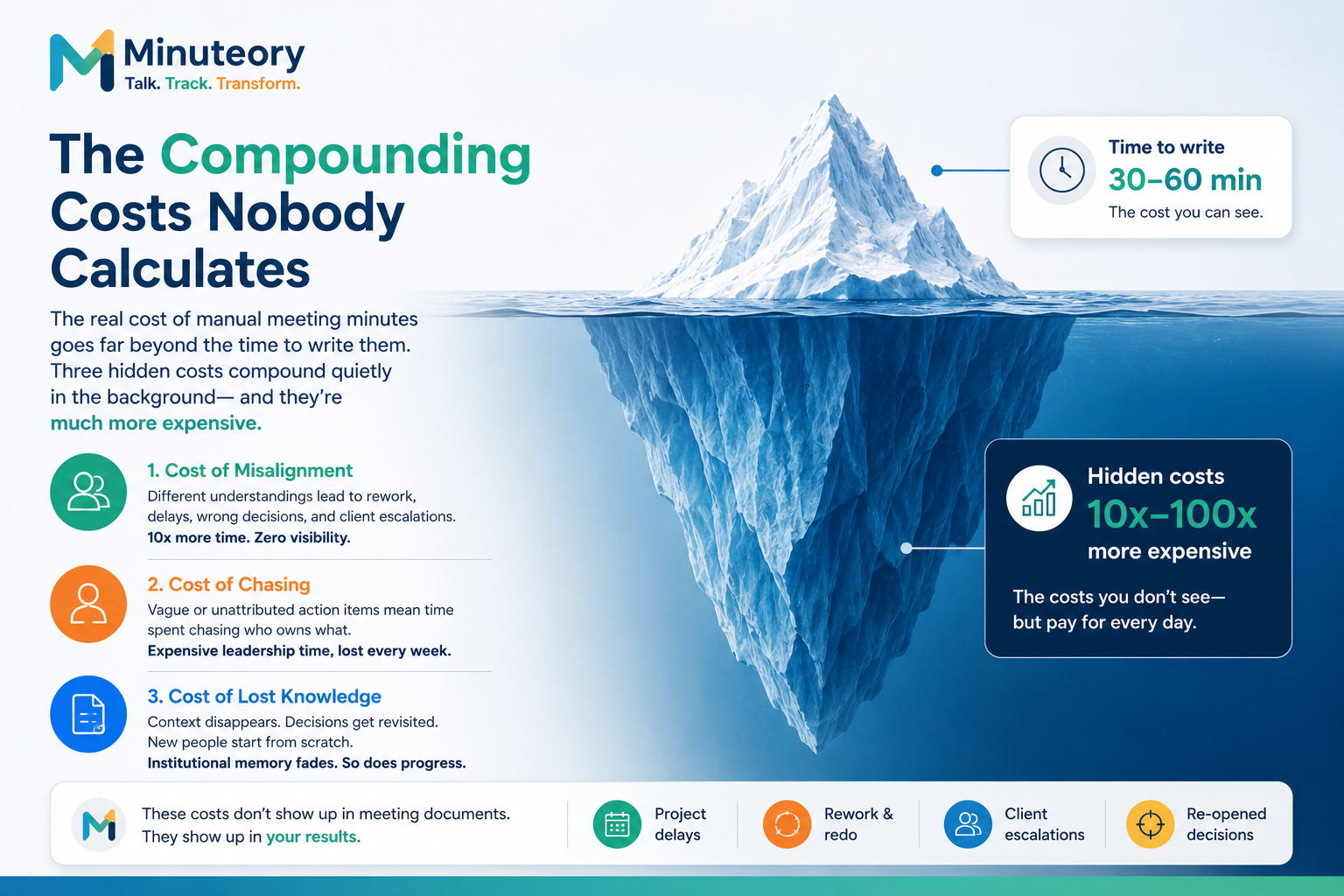
Beyond the time to write the minutes, three other costs compound quietly in the background.
The first is the cost of misalignment. When two people who were in the same meeting leave with different understandings of what was decided, the correction does not happen immediately. It surfaces later, often at the worst possible moment. A deliverable goes in the wrong direction. A client receives the wrong information. A team member makes a decision based on what they thought was agreed, only to find out two weeks later that the agreement was understood differently by everyone else in the room.
The time lost to correcting misalignment is an order of magnitude larger than the time spent writing the original notes. But it never gets attributed to the meeting. It shows up as project delays, rework, client escalations, and re-opened decisions. The meeting appears to have been fine. The costs of it being documented badly are distributed invisibly across everything that came after.
The second is the cost of chasing. When action items from a meeting are vague or unattributed, someone has to spend time after the meeting finding out who owns what. This is usually the most senior person in the room: the founder, the COO, the project lead. Their time, used to reconstruct accountability that should have been established before the meeting ended, is the most expensive administrative work in the organisation.
I tracked this in my own team at one point. The time I spent each week following up on commitments that had been made in meetings but not clearly assigned was equivalent to almost half a working day. Not doing strategic work. Not leading. Chasing.
The third is the cost of lost institutional knowledge. Meeting notes that are written quickly, stored in a document no one revisits, and never connected to the projects and decisions they relate to are not institutional memory. They are noise. The real knowledge of why a decision was made, what alternatives were considered, and what the context was at the time of the decision disappears within weeks.
When a new person joins the team, or when a decision needs to be revisited six months later, that context is gone. Someone reconstructs it from memory, probably imperfectly. The organisation makes decisions without understanding the thinking that produced previous ones.
Why the Template Does Not Fix It
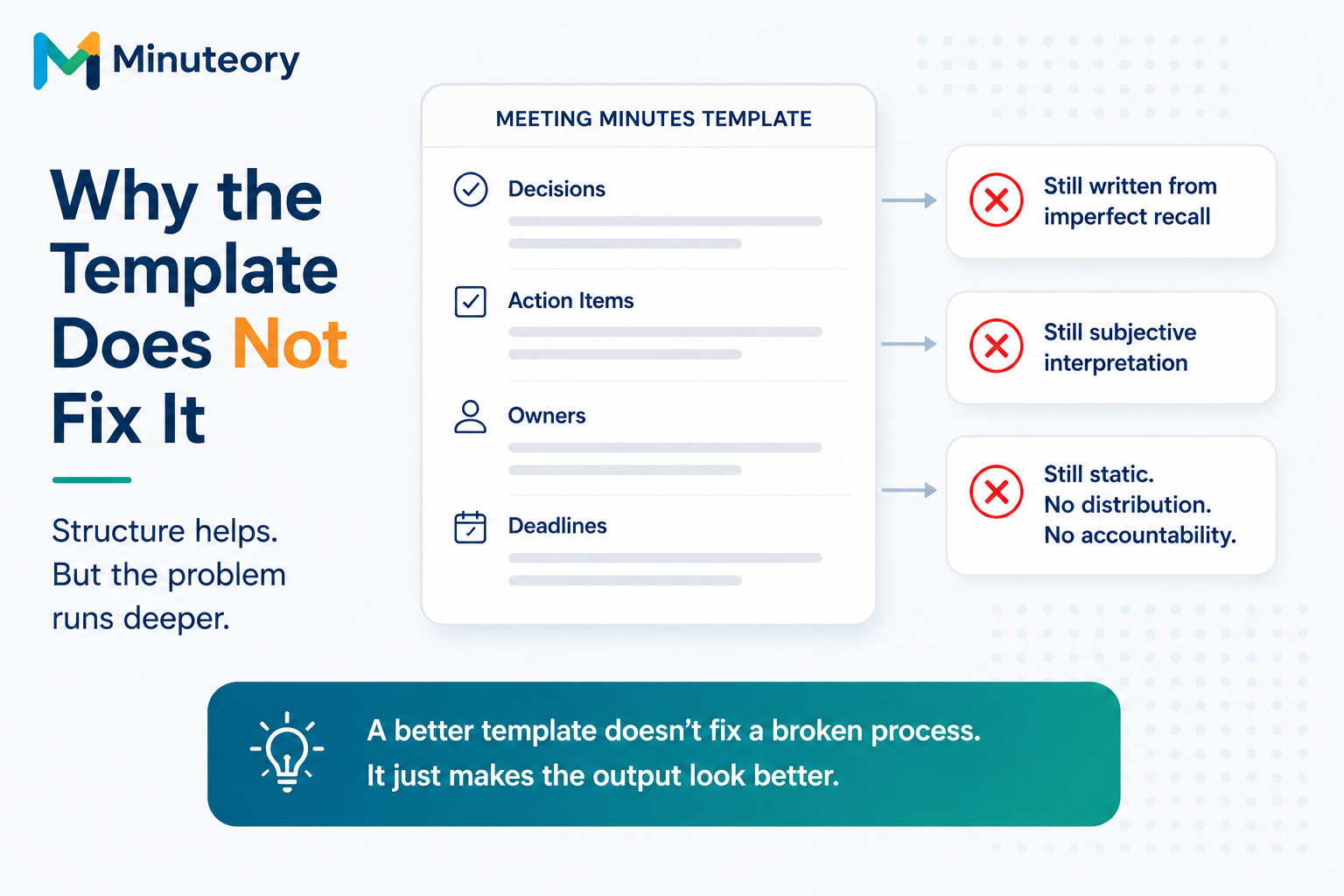
The instinct when this problem is recognised is to create a better template. A structured format for meeting notes with designated sections for decisions, action items, owners, and deadlines. This is a reasonable instinct and it is not enough.
A template improves the structure of what gets written. It does not change the fundamental problem: the person writing against the template was also in the meeting, has imperfect recall, and is interpreting what happened through their own understanding of it. A well-formatted document produced from a partial and subjective record is still a partial and subjective record.
Templates also do not solve the distribution problem. A meeting document, however well formatted, is static. It does not push tasks to the people who own them. It does not appear in anyone's task management system. It does not send a notification when a deadline passes. The accountability that needs to move from the meeting into the work of the team requires active distribution, and templates do not provide that.
What Changes When the Process Changes
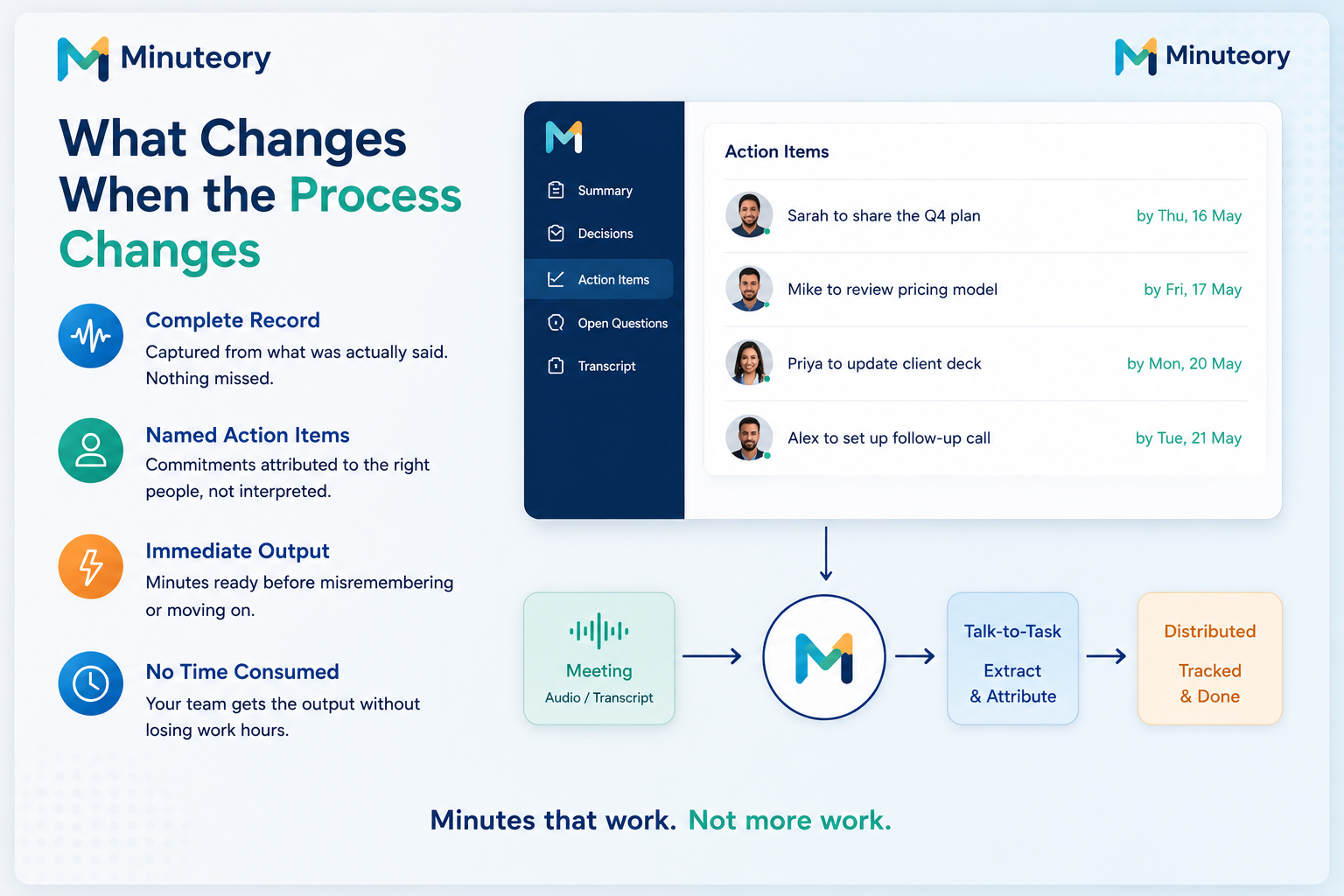
The shift I was looking for was not a better way to write notes. It was removing the writing from the equation entirely and capturing what actually happened in the meeting rather than one person's reconstruction of it.
When a meeting is processed from the transcript rather than from someone's recollection, several things change at once.
The record is complete. Nothing is missed because the person writing was talking at the same moment. Every decision, every commitment, every piece of context is captured from what was actually said, not from what was remembered.
The action items are named. Not interpreted. The system reads who committed to doing what and records it that way. The ambiguity of "team to follow up" does not survive contact with a transcript where one specific person said "I will have that ready by Thursday."
The output is immediate. The minutes do not arrive the next day, after the writer has had other meetings and competing priorities. They are available before anyone has had time to misremember or move on.
And critically, the process does not consume anyone's working time to produce that output.
How Minuteory Handles This
Minuteory processes every meeting from the audio or transcript and produces the full documentation automatically: summary, decisions made, open questions, and a complete action item list with named owners extracted from what was actually said in the room.
The Talk-to-Task layer reads the conversation and identifies every commitment made, attributing each one to the person who made it. The output is not a set of notes for a human to interpret. It is a structured record with owners already attached, ready to be distributed and tracked.
For teams running multiple meetings per day across different projects and clients, this is the difference between meeting admin that consumes hours and meeting output that is ready within minutes of the call ending. The cost that was invisible is not just reduced. It is removed from the equation.
One Way to Make the Real Cost Visible
Before changing any process, do one thing. Take the last five meetings your team ran. For each one, answer three questions honestly.
How long did it take to write up the notes? How long did it take for every action item to have a confirmed owner and deadline? How much time was spent in the following week resolving confusion about what was decided or who was responsible for what?
Add those numbers together across the five meetings. Then multiply by fifty to see what that looks like annually.
The hour your team spends writing up meetings is the cost you can see. What you will find in that exercise is that the cost you cannot see is the one worth fixing.
If you want to see what the process looks like when the documentation, task assignment, and ownership record are produced automatically, start at app.minuteory.com and run it against a real meeting today.