
What RACI Actually Means When You Apply It to Meeting Tasks
Every founder and operations leader has heard of RACI. Responsible, Accountable, Consulted, Informed. It shows up in onboarding decks, project management courses, and team retrospectives. Most people nod when they see it.
Very few actually use it.
Not because the framework is wrong, but because applying it manually to the output of real meetings is too slow, too inconsistent, and too dependent on whoever is running the post-meeting admin that day. The result is that RACI stays theoretical while the actual accountability problems it was designed to solve keep happening.
This post is about what changes when you apply RACI not as a project management exercise but as an automatic output of every meeting you run.
What RACI Meeting Tasks Actually Are
There is a particular kind of silence that follows a good meeting. Everyone agreed on the work. Someone said they would handle the follow up. Then the room emptied and the commitment quietly lost its owner. I have watched this happen more times than I can count, and it almost never breaks in the moment. It breaks three days later, when nobody is sure whether the thing that was clearly agreed was ever clearly assigned.
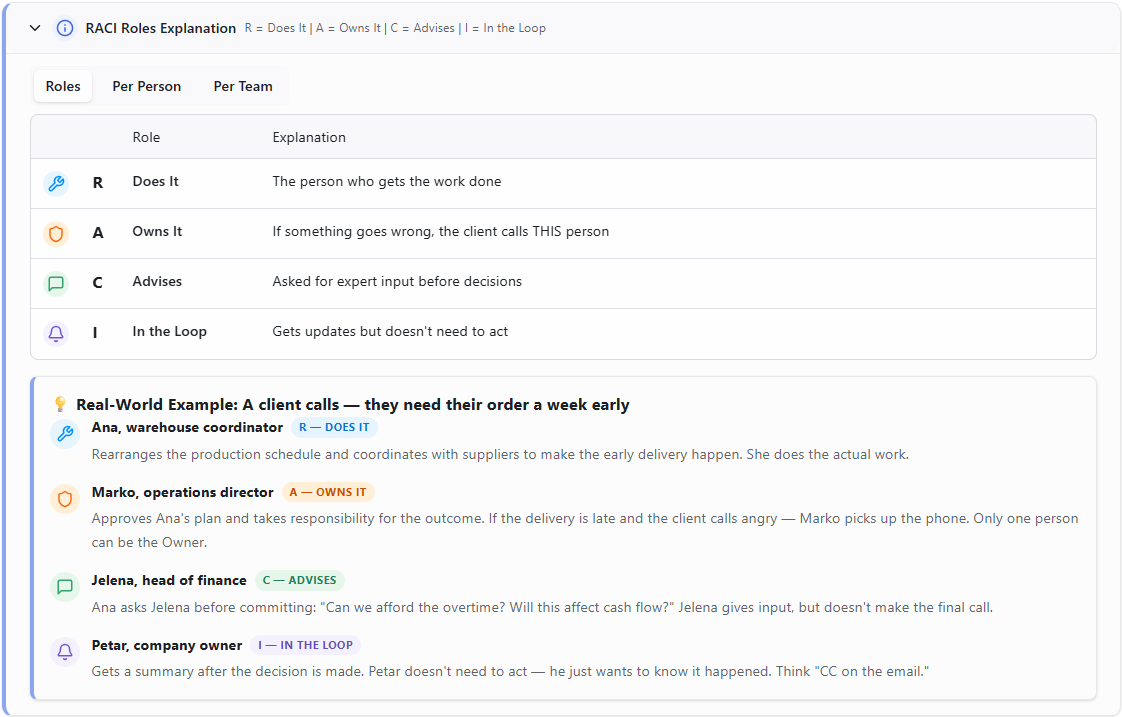
RACI meeting tasks are the answer to that silence. RACI is a way of naming, for every action item, who does the work and who owns the outcome. Responsible is the person who does it. Accountable is the single person who owns it, the one who gets the call if it does not happen. Consulted is the expert whose input is needed before a decision. Informed is the person who needs to be kept in the loop. The rule that makes it hold is small and strict. Every task has exactly one accountable owner. Not two, not the whole room, one.
Most teams already understand responsibility. What they lose in the rush out of a meeting is accountability, the named owner. When everyone is accountable, nobody is, and the follow up becomes the thing that everybody assumed somebody else would carry. Responsible and accountable meeting tasks stop being a chart on a wall and start being the answer to a simple question asked in the room: who owns the follow up after this meeting.
Why a RACI Chart Is Not the Same as an Owned Follow Up
Plenty of teams already know what RACI is. There are templates for it, guides that walk through it, whole afternoons spent filling in a grid of who is Responsible and who is Accountable across a project. I have built those grids. They look reassuring on the wall. The trouble is that a chart made once at the start of a project has almost nothing to do with the commitment somebody made out loud in yesterday's meeting.
That is the gap every version of this advice keeps missing. The question that actually decides whether work happens is not who owns this project. It is who owns the follow up from this meeting, the specific thing that was agreed twenty minutes ago, and whether that person carries it before the same group sits down again. Capture is not accountability. A recording that writes down every word still leaves the owner unnamed, which is worth understanding alongside what your meeting AI does after it writes the summary. And a RACI chart, however carefully built, is not completion. It assigns a role once and then goes quiet while the real tasks drift.
What a recurring meeting needs is RACI applied to its output, not to a static plan. Every action item that comes out of the room gets a single accountable owner drawn straight from what was said. That owner stays attached to the task, and each meeting shows which of its commitments were carried and which slipped. The same discipline holds when you run meetings for several organizations at once, which is covered in meeting accountability across multiple clients. When meetings are connected into a series, the next session opens already knowing what the last one left open. And because each meeting scores how well every person carried the roles they held, you stop guessing who follows through. A chart tells you who should own the work. This tells you, meeting after meeting, whether they actually did.
Why RACI Exists in the First Place
RACI was designed to solve one specific problem: when more than one person is involved in a task, accountability disappears.
This is not a personality problem. It is a structural one. When three people leave a meeting all understanding they were part of a discussion about a deliverable, each of them reasonably assumes one of the others is handling it. No one is being irresponsible. The assignment was simply never made specific enough for responsibility to land on a single person.
RACI solves this by forcing clarity on four distinct roles for every action item.
Responsible is the person who does the work. Accountable is the person who owns the outcome, the one who answers for it if it does not happen. Consulted are the people whose input is needed before the task is complete. Informed are the people who need to know when it is done.
The distinction between Responsible and Accountable is the one most teams miss. You can delegate responsibility. You cannot delegate accountability. Someone has to own the outcome, and that person needs to know they own it before the meeting ends.
What Happens Without It
Without RACI applied to meeting tasks, three patterns repeat across almost every team.
Tasks get assigned to roles rather than people. "Marketing will follow up on this" means no individual has been named. When the deadline arrives and nothing has happened, everyone in marketing thought someone else was on it.
Verbal commitments fade. The person who committed verbally never had it confirmed in writing with their name on it. Verbal commitments made in fast-moving meetings fade quickly. By the time the next week arrives, the commitment exists only in someone's memory and a set of rough notes that may or may not capture it accurately.
No one knows who to update. When a task is complete, or blocked, or changed in scope, there is no list of who needs to be told. Updates go to whoever seems relevant at the time, which means some people are over-informed and others find out about critical changes far too late.
These are not communication failures. They are accountability infrastructure failures. And they are entirely fixable.
The Manual Implementation Problem
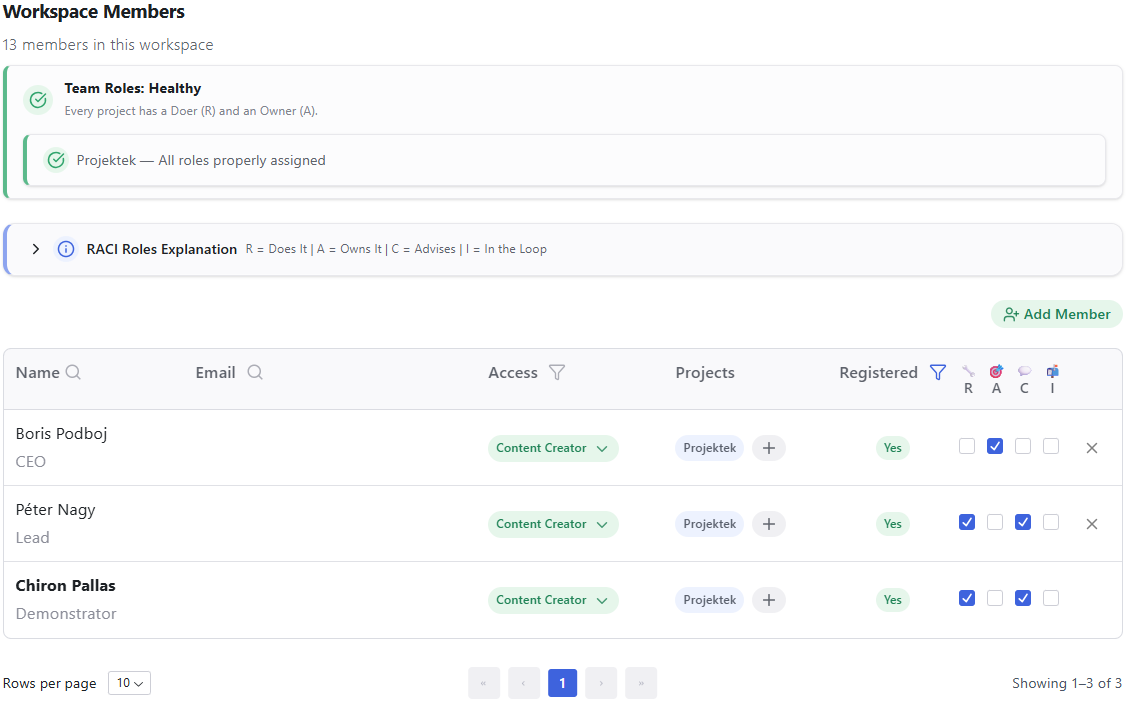
If you have tried to implement RACI in your team meetings, you already know the problem. Filling in a RACI matrix during or after a meeting is slow, disruptive, and often incomplete.
Meeting conversations move fast. A task gets mentioned, attributed, agreed on, and the conversation moves forward in seconds. By the time someone catches it and tries to formally assign RACI roles, the team is three topics ahead. The person facilitating the meeting is either doing that or participating in the discussion. Rarely both well.
The post-meeting admin version is worse. Someone takes the rough notes from the meeting, tries to reconstruct which tasks were assigned and to whom, and then builds a RACI assignment from memory. This introduces two failure points: the tasks themselves may be misremembered or missed entirely, and the role assignments are the facilitator's interpretation rather than what was actually said.
Manual RACI implementation also does not scale. It is hard to sustain for one meeting per week. For a team running daily standups, client calls, project reviews, and board updates simultaneously, it collapses almost immediately.
How Minuteory Turns Every Meeting Into RACI Meeting Tasks
The reason Minuteory built RACI into the task extraction layer rather than treating it as a reporting feature is that accountability only works if it is assigned at the moment of commitment, not reconstructed afterward.
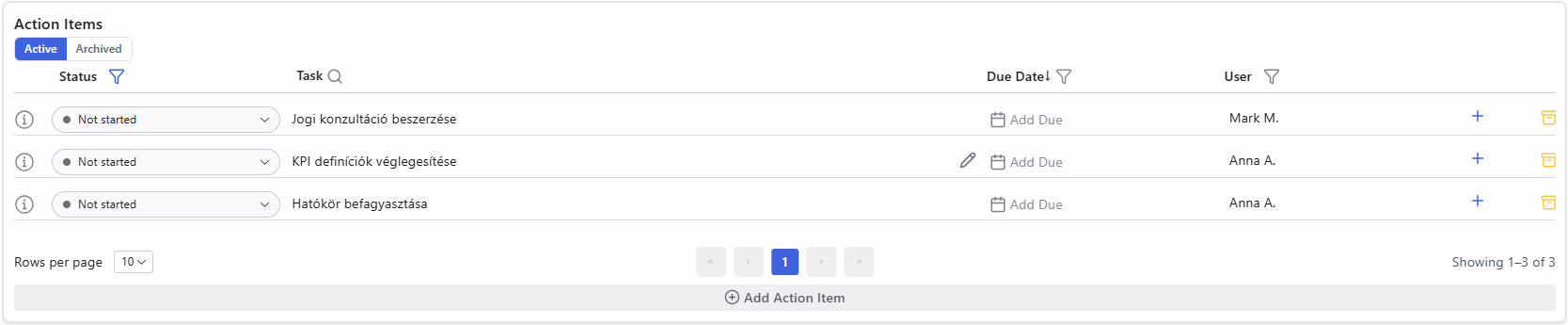
Minuteory reads the meeting and extracts the action items with named owners, then holds each one inside the RACI framework so the accountable owner is explicit rather than assumed. Each task shows which meeting it came from, so the commitment and its owner stay attached to the moment they were made, and the person marked accountable is the one who can update and close it. Meetings that belong together can be connected into a thread, so the next session opens with what the last one left open. After each meeting, the same RACI roles feed an assessment of how well each participant carried what they owned, so accountability is not only assigned in the room, it stays visible over time.
When a meeting is processed, Minuteory reads the conversation and identifies every action item, decision, and commitment made during the call. For each one, it assigns RACI roles based on who said what: who committed to doing the work, who owns the outcome, who was asked for input, and who needs to be kept in the loop.
This happens automatically, without anyone needing to pause the meeting, fill in a matrix, or spend thirty minutes on post-meeting admin. The output is a structured task list where every item already has a full RACI assignment attached to it before the meeting ends.
For the person who is Responsible, the task appears clearly attributed to them. For the person who is Accountable, the outcome is on record in their name. For people who are Consulted or Informed, the system knows to include them in relevant updates without anyone having to manually decide who needs to know what.
Why This Changes the Accountability Conversation
The most common accountability conversation in growing teams sounds like this: "I thought you were handling that." "I thought it was on your list." "No one told me it was urgent."
That conversation is almost always a symptom of the same root cause: no one had a clear, written, named record of who owned what before the meeting ended.
When RACI is applied automatically to every task that comes out of every meeting, that conversation stops. Not because people change, but because the ambiguity that produces it no longer exists. Every person who leaves a meeting knows exactly what they own, exactly who is accountable for the outcome, and exactly who needs to be told when it is done.
For founders and operations leaders, the shift is significant. Instead of spending time chasing updates, investigating why things did not happen, and re-assigning work that was supposedly already assigned, the accountability record exists before anyone leaves the room. Follow-up becomes a check on a known list rather than a reconstruction of an ambiguous one.
The Scale Dimension
RACI applied to one meeting per week is useful. RACI applied to every meeting your organisation runs, automatically, over months, is a completely different capability.
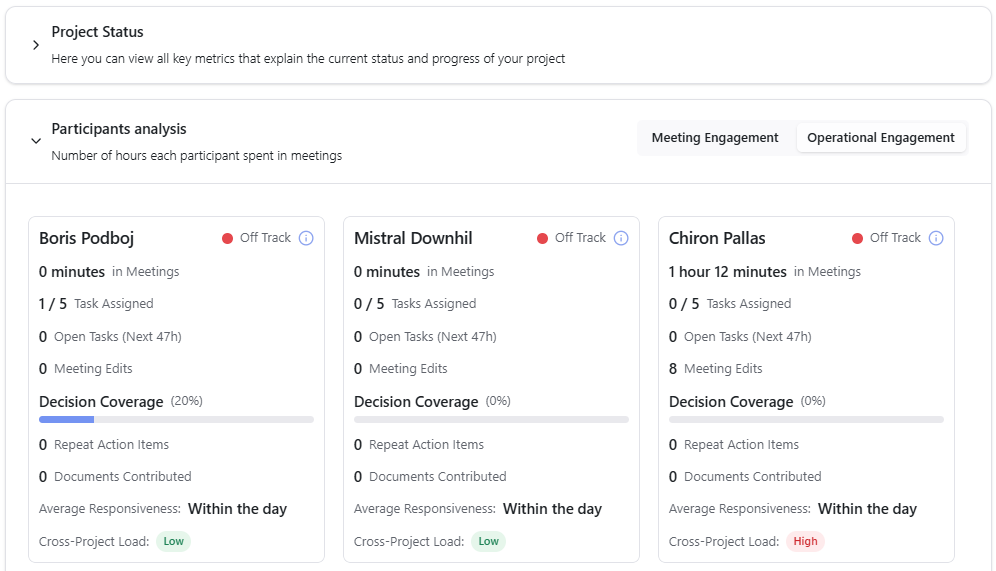
When every task from every meeting carries a consistent RACI structure, you can see patterns that are otherwise invisible. Which team members consistently end up Accountable for outcomes outside their stated role. Which meetings produce tasks with clear ownership and which ones produce tasks that nobody owns. Which individuals are over-consulted on everything and therefore a bottleneck, and which ones are never consulted on decisions that affect their work.
This is not meeting admin. This is organisational intelligence. And it is only available when RACI is applied consistently enough to produce reliable data across time.
Minuteory builds this picture automatically as a by-product of processing every meeting. The accountability layer is not an extra step. It is the default output.
What to Check in Your Own Team This Week
Before the next meeting your team runs, ask one question: when a task comes out of this meeting, will every person involved know whether they are Responsible, Accountable, Consulted, or Informed?
If the honest answer is no, you have the accountability gap that RACI was designed to close.
Minuteory applies the full RACI framework to every task automatically, without anyone needing to do extra work before, during, or after the meeting. If your team is running meetings that produce commitments nobody owns, it is worth seeing what the output looks like when the accountability structure is already built in.