
How to Build a Meeting Culture That Actually Produces Business Results
When a company is small, no one talks about meeting culture. It does not have one, or rather it has one without noticing, the way a small kitchen has a system that only becomes visible the day a second cook walks in.
Everyone is in every conversation. A decision made at the coffee machine is known by the whole company an hour later. Context does not have to be managed because it is shared by default. Meetings are short because the people in them already understand the situation, and whatever is agreed simply happens, because the person who will do it is usually the person who has just agreed to it.
Then it grows. Not dramatically, just enough. More people, more projects, more meetings to hold the projects together. And somewhere in that growth the thing that had worked quietly stops working. The team is busier than ever and moving slower than before. The calendar is full. The output does not match the effort. A leader can look at a week of back to back meetings and realize they cannot name a single decision from it that has actually reached the people who need to act on it.
That is when it becomes clear that meeting culture is not a soft thing you get to ignore while you focus on the real work. It is the operating system the real work runs on. As a company grows, that operating system either compounds into results or quietly turns into overhead.

Why meetings multiply faster than results
Most growing teams feel this long before they can name it. A group that settled decisions in one conversation when it was small finds, somewhere along the way, that the same kind of decision now takes a week and three meetings. Nobody got lazier and nobody got worse at their job. Something structural shifted, and the clearest explanation for it comes from Fred Brooks.
In The Mythical Man-Month, published in 1975, Brooks gives the arithmetic that every growing team feels but few can explain. A team of n people carries n(n minus 1) divided by 2 communication lines. Five people carry 10 of them. Forty people carry 780. The lines do not grow with your headcount, they grow with the square of it. That is the real reason meetings multiply faster than output as a company grows. It is not a motivation problem and it is not culture in the soft sense. It is arithmetic.
Brooks drew the harder conclusion too, the one now known as Brooks' Law. Adding people to a team does not add output in a straight line, because every new person adds new communication paths, and every path carries a cost in time and attention. Growth quietly taxes itself, and the tax is paid in meetings.
You cannot repeal the arithmetic. What you can change is what each of those lines carries. A communication line that ends in a named owner and a tracked commitment is productive. A line that ends in a shared understanding everyone later remembers differently is pure overhead. Meeting culture in a growing company is really the discipline of making each of those lines end in accountability instead of ambiguity.

Why the Usual Fixes Never Reach Your Meeting Culture
The common response is to manage the symptom. Leaders cap meeting length, declare a no meeting day, cut the invite list, or roll out a culture deck that lists the values the company is supposed to hold. These moves are reasonable and none of them reaches the actual problem.
Fewer and shorter meetings can make a bad meeting culture cheaper, but a cheaper bad culture is still a bad culture. If the meetings you keep still end without a clear purpose or an owned outcome, trimming the calendar just spreads the same failure across less time. A culture deck has the same flaw a values poster always has. It describes the behaviour you want in a document, while the behaviour itself happens in a specific room on a specific afternoon and either produced a result or did not.
The deeper reason these fixes fall short is that they treat meeting culture as a matter of taste or discipline, something you exhort people toward, when it is really a matter of measurement. You cannot improve what you only feel. A leader can sense that meetings have gotten heavier and results have gotten lighter, but a feeling does not tell you which meetings, which teams, or which part of the meeting broke. Without that, every intervention is a guess, and growing companies do not have the time to guess the same problem twice.
Making Meeting Culture Produce Business Results
The reason a tool like Minuteory matters is that the small company version of this does not survive scale. In a small team, the founder is the measurement system. They can feel whether a meeting has a point and whether the thing agreed actually happens, because they are in every room. That does not translate to a larger team, and it certainly does not translate to a founder who wants to stop being the human glue holding coordination together.
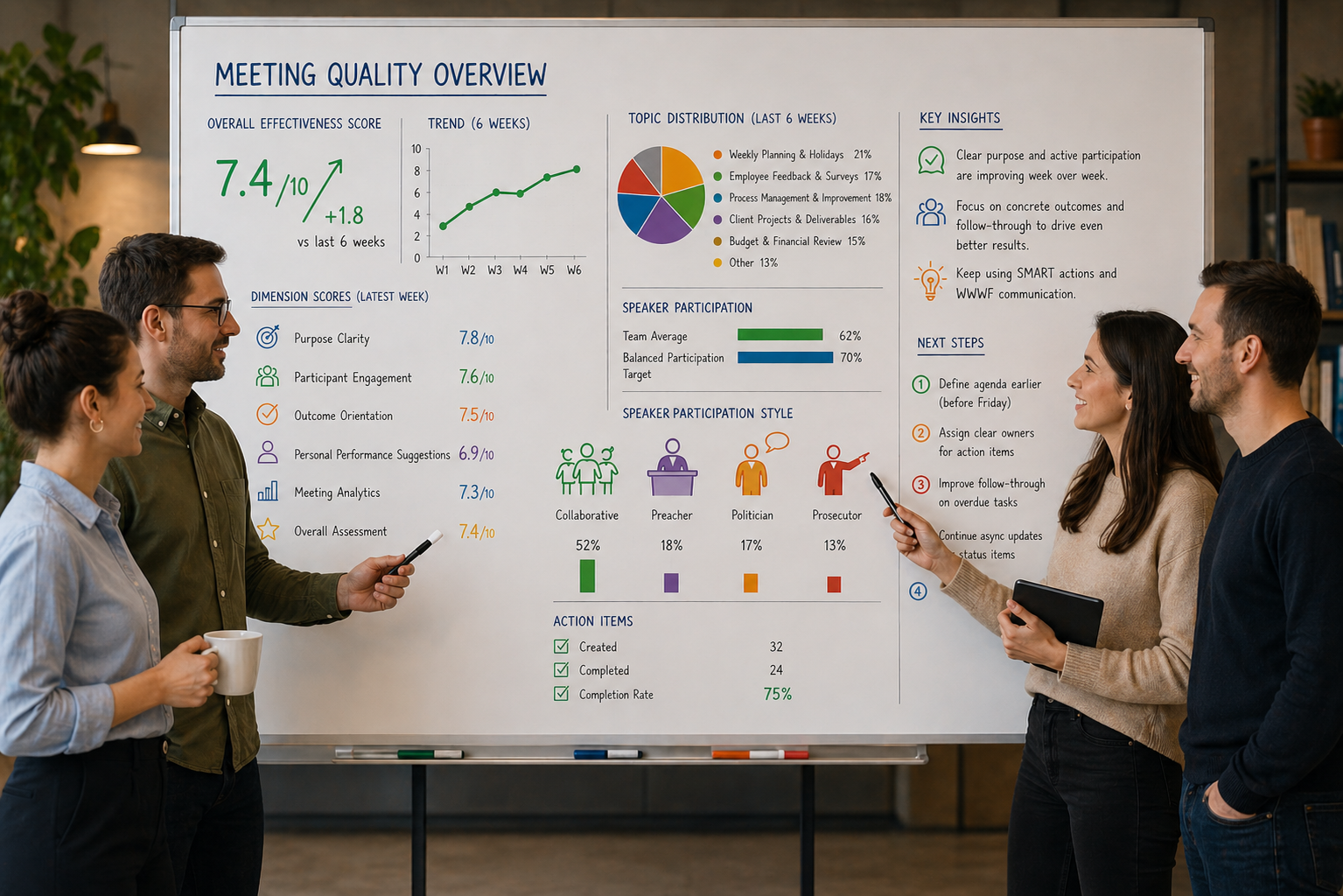
So Minuteory scores every meeting across six effectiveness dimensions, and the two that matter most for a growing company are the ones that tie a conversation to a result. Purpose Clarity assesses whether the meeting was necessary at all, whether there was a clear agenda, and whether the people in the room understood the goal. Outcome Orientation assesses whether the meeting actually produced concrete outcomes and next steps rather than a warm feeling of alignment. Together they turn the vague question of whether a meeting was good into something you can see.
The connection to business results comes from what happens to those outcomes. Minuteory extracts the tasks a meeting produces and assigns them with RACI accountability, so every action item has someone who owns it, and each person can open their My Tasks view and see everything they are responsible for across every project. This is the exact bridge that breaks in a growing company. The conversation becomes a set of owned commitments instead of a shared memory that fades by Friday. Culture, in the end, is just whether the things a company decides get done, and this is where the deciding turns into the doing.
Then the view widens. Organization Meeting Analytics lets an admin configure how each type of meeting in the company is scored and see effectiveness across teams rather than one room at a time, and the Quality Trend built across a group of connected meetings shows whether a recurring meeting is getting sharper or slowly losing its edge over the weeks. That is the difference between a founder guessing about culture and a company that can watch its meeting culture the way it watches revenue, as a line that moves and that someone is responsible for.
A Test You Can Run on Your Meeting Culture This Week
You can start measuring this before you touch any tool. Pick the three most attended recurring meetings in your company, the ones that pull the most people off other work each week. For the last month of each, ask three plain questions. Did the meeting have a clearly stated purpose that everyone understood. Did it end with concrete next steps rather than general agreement. And did each of those next steps leave the room with a single named owner.
Now hold that against your growth. If the number of people in these meetings has climbed while the number of clearly owned outcomes has stayed flat or fallen, you have found the exact place where your meeting culture is turning growth into overhead instead of results. That gap, between how many people you are spending and how many owned outcomes you get back, is the truest measure of whether your meeting culture is producing business results or quietly consuming them.
Meeting culture is not a poster or a personality. In a growing company it is the machinery that decides whether decisions become results or evaporate between rooms, and the only way to run it well at scale is to be able to see it. That is what Minuteory is built to give you, a clear read on whether every meeting had a purpose, produced an outcome, and handed that outcome to someone who owns it, tracked across your whole company as it grows.