
Why Your Team Stops Being Honest in Meetings
In the third month of a project I was running, I noticed the retrospectives had gone quiet in a way I could not name at first.
They were still happening. Everyone showed up. The agenda had not changed. But the room had. In month one people had said the hard things plainly. By month three the same people were agreeing at the surface, nodding through problems instead of naming them, and leaving with everyone apparently aligned and nothing actually resolved.
It took me weeks to understand what had shifted. The team had learned a quiet lesson. Being specific about what had gone wrong created more work. Naming a problem meant owning a fix. Staying vague was safer. So the meetings kept their shape and lost their substance. They looked productive. The outputs told a different story.
That was the moment I stopped believing an honest meeting culture is something you set once and keep. Honesty in meetings is not a fixed trait of your team. It is a behaviour that responds to incentives, and most teams are quietly training it out of the room without ever deciding to.

What Honesty Actually Costs the Person Who Offers It
Every time someone says the true thing in a meeting, they pay for it. They might pick up the task that comes attached to the problem they just named. They might extend a meeting that everyone wanted to end. They might contradict the person who runs the room. None of this is dramatic. It is a small, repeated tax on candor.
When that tax gets paid often enough with nothing in return, people stop volunteering to pay it. They do not announce that they have stopped. They simply soften. A flat problem becomes something we should probably look at. A missed commitment becomes a thing that got a bit delayed. A disagreement becomes silence followed by a nod.
This is why the strongest signal a team gives you is rarely what gets said. It is what stops being said. The most useful sentence in a meeting is often the one that nobody is willing to be the first to speak, and by the time a team has gone quiet on the hard topics, the meeting has become a performance of alignment rather than a place where alignment is actually built.
The damage is not only in that one room. A problem that goes unnamed does not disappear. It moves downstream, where it costs more to fix and where nobody can point to the moment it could have been caught. The team that stopped naming things in the retrospective still ships the consequences of those things in the next sprint. What looked like a calmer meeting was really a more expensive one, paid for later by people who were not in the room when the silence happened.

Why Asking for People to Be Honest in Meetings Does Not Make Them Honest
The common fix is to ask for it. Leaders say be candid, add a slide about psychological safety, or run an anonymous survey once a quarter. These are not bad instincts. The trouble is that they treat honesty as a value to be declared rather than a behaviour to be observed.
A value lives on a wall. A behaviour happens in a specific room on a specific Tuesday, and it either happened or it did not. Asking a team to be more honest while every honest contribution still carries a private cost is like asking water to flow uphill because you put up a sign. The incentive in the room beats the instruction every time.
The survey has the same blind spot. It is quarterly and the meeting is weekly. By the time low team honesty shows up in a culture score, the candor has already been gone for months, and you are reading a report about a problem that started long before the data caught it. You cannot manage what you only see twice a year, and you certainly cannot catch a slow erosion that way. The decline is gradual by nature. It hides inside meetings that still look fine from the outside.
Making Team Honesty in Meetings Visible
When I finally fixed this on that project, I did it the slow way. I went back through the records and the notes, I paid attention to who had gone quiet and on which topics, and I made the agreed record the thing the team treated as true rather than the softened version people remembered. It worked, but it depended entirely on me having the time to read closely, and most weeks I did not.
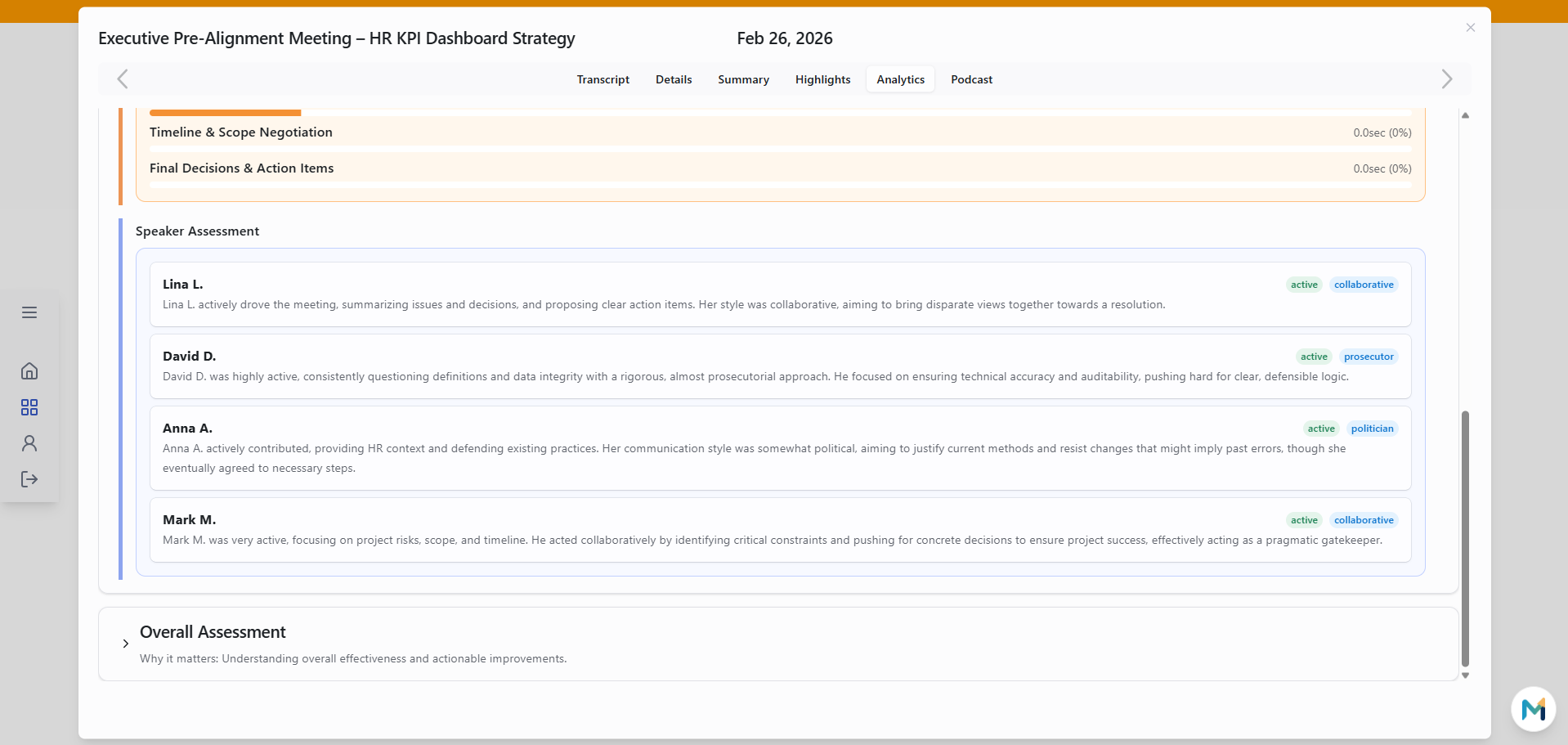
That experience is the reason this kind of reading is built into Minuteory rather than left to whoever has a free afternoon. Minuteory scores every meeting across six effectiveness dimensions, and two of them speak directly to honesty in the room. Participant Engagement assesses whether the right people were present and, more importantly, whether all voices were actually being heard and whether participants were contributing rather than going quiet. Personal Performance Suggestions adds role specific feedback on how each person showed up.
Underneath the scores sits the part that matters most for a culture question. The Meeting Analytics view produces a Speaker Assessment, a card for each participant that describes their communication behaviour, their contribution style, and their engagement pattern through the meeting in plain language. You are no longer guessing whether someone has pulled back. You can see that the person who used to drive the hard parts of the conversation has gone quiet, and you can see it in the meeting after it happened, not in a survey three months later.
The strongest signal comes when you stop looking at one meeting and start looking at a series. Minuteory builds a Quality Trend across a group of related meetings, so a recurring retrospective or weekly review is tracked as a connected story over time rather than a set of isolated events. That is where the silent decline I lived through becomes a line you can actually see. Which meeting type is getting sharper and which is slowly losing its edge. Which person is contributing differently now than they were four sessions ago. The honesty was leaving the room the whole time. The difference is whether anyone could see it while there was still time to respond.
A Test You Can Run This Week
You do not need a tool to start. Pull the records or notes from the last three sessions of one recurring meeting, the same type each time, ideally a retrospective or a review where problems are supposed to surface. For each session, count two things. How many problems were named specifically, with a clear owner. And how many were softened into something vague that committed no one.
Then put the three sessions side by side, oldest first. If the count of specific, owned problems is falling while the meeting itself looks just as busy, you are not watching your team run out of problems. You are watching them learn that naming problems costs more than staying quiet. That trend line is the real state of your meeting culture, and it is almost always visible weeks before anyone says a word about morale.
Once you have seen it by hand, the question stops being whether honesty is fading and becomes how often you want to check. That is the gap Minuteory is built to close, by reading every meeting the way I had to read that project by hand, and showing you the trend while you can still do something about it.