
Microsoft 365 Copilot vs Minuteory: What Happens After the Meeting Summary
I was on a call with a founder last month who told me his team had been using Microsoft 365 Copilot for three months. The summaries were excellent, he said. Detailed, clean, structured. The problem was that nothing in those summaries was actually moving. The action items sat in the notes the same way they had always sat in the notes, except now the notes were better formatted.
He asked me what I thought was going wrong. I told him I thought he was solving the wrong problem. The bottleneck in most teams is not that people forget what was said. It is that nobody knows who is actually responsible for what, and nobody is watching whether it moves.
What Microsoft 365 Copilot Does Well
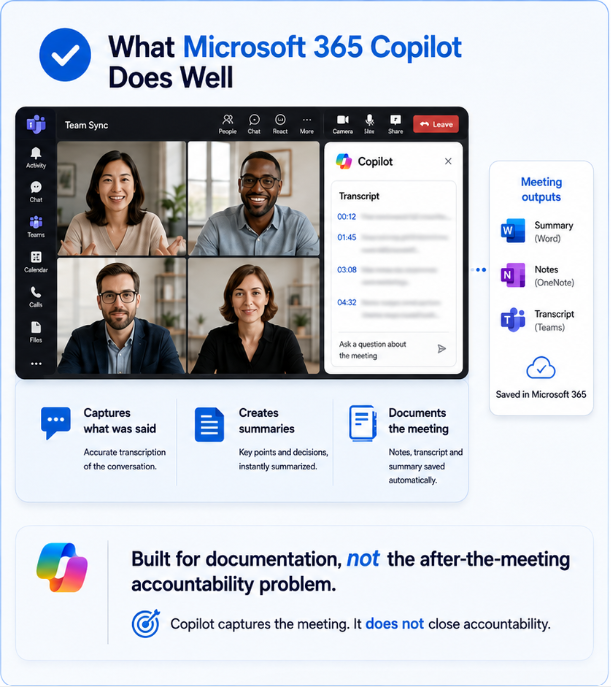
Microsoft 365 Copilot is a powerful transcription and summarisation tool. It sits inside the Microsoft 365 ecosystem, picks up Teams calls, and produces a written record of what happened. For teams already inside that ecosystem it is genuinely useful. The summary arrives without anyone having to write it. The notes exist. The meeting is documented.
That is the end of what it does.
Copilot now extracts action items and can assign them to named individuals based on the transcript, and those tasks can sync to Microsoft Planner or To Do. That is genuinely useful. But the assignment comes from what Copilot inferred from the conversation — the person listed may not know they own it, may not have acknowledged it, and has no system pulling them back to it before the next meeting. When the meeting ends, you have a record of what Copilot thought was agreed. You do not have confirmation that accountability actually landed anywhere.
This is not a criticism of the tool. It was not built to solve the after-the-meeting problem. It was built to solve the documentation problem, and it solves that well. The gap is what happens next.
Why Meeting Action Items Stop Moving
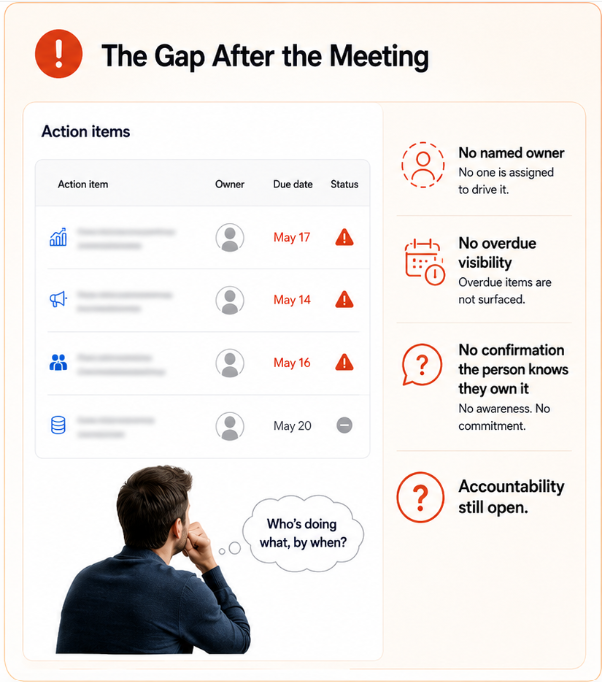
Most teams treat the meeting summary as the output of a meeting. It is not. The summary is a record of intent. The output is whether those intentions became real work with a named person, a deadline, and movement you can see.
The pattern I see most often is this. A meeting produces five action items. They go into the notes. Two people interpret one of the items as belonging to the other. A third item is listed under a name but that person was only mentioned in passing and does not know they own it. One item gets done because someone cared enough to chase it. The other four sit until the next meeting, where they are mentioned again, and the cycle repeats.
This is what I mean when I say meeting action items are not getting done. It is rarely because people are lazy. It is because the accountability was never actually established. The notes say what should happen. They do not say who owns it in a way that person has acknowledged and accepted. Without that, every action item is a suggestion.
For a deeper look at how named ownership works in practice, the post on how RACI assigns a named owner to every meeting task walks through the mechanics in detail. For a view of where your meeting data actually lives once it has been processed, the post on EU data residency covers that in full.
The Minuteory Layer
Minuteory starts where Copilot stops. You upload the recording — or connect your Google Drive, or record directly in the browser — and Minuteory does the transcription and summary the same way any modern AI meeting tool does. But it does not stop at the document.
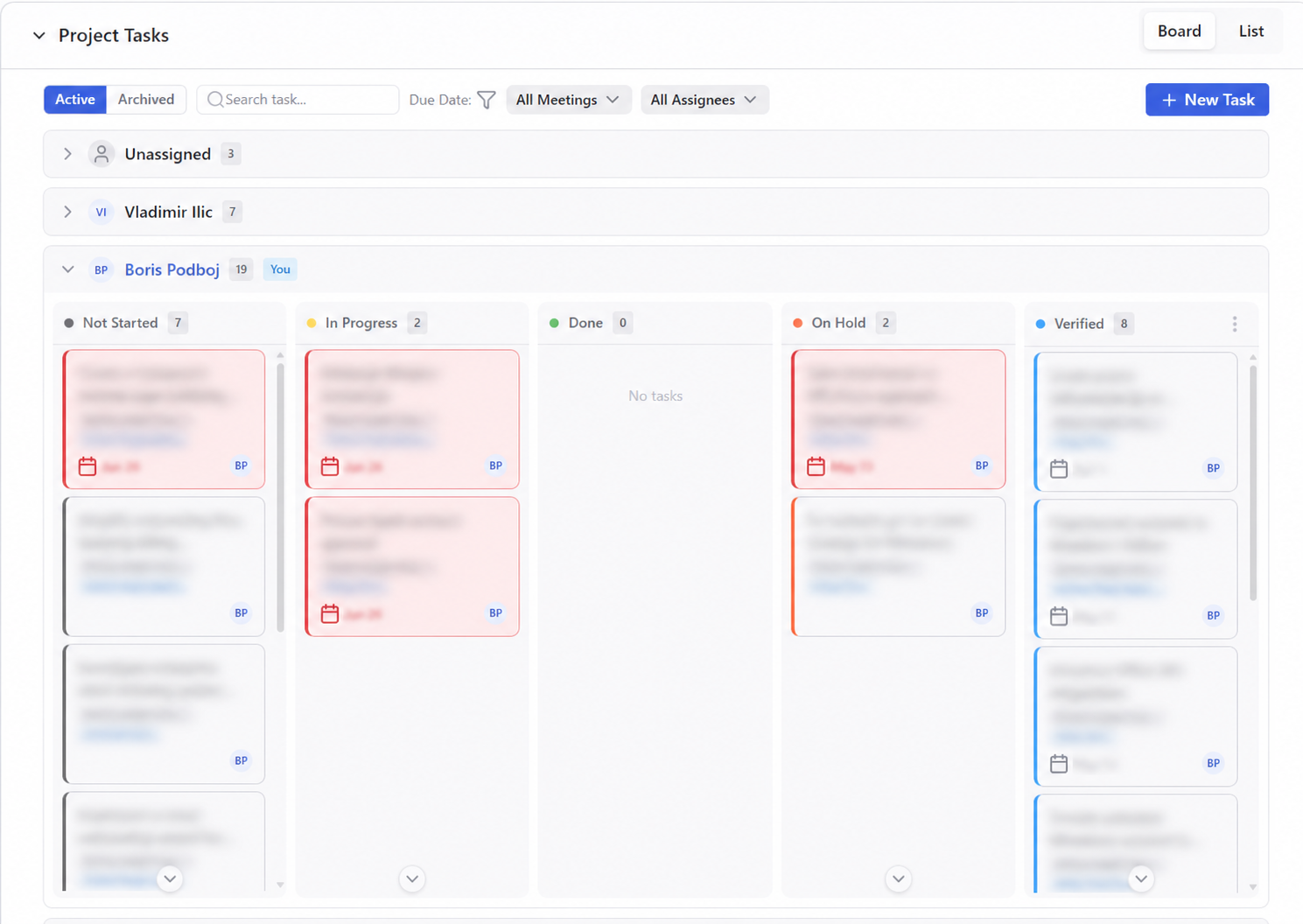
Every action item extracted from the meeting gets assigned using RACI: a named person who Does It, a named person who Owns It, someone who Advises, and someone who is kept In the Loop. That assignment is not an annotation in a document. It is a task in the system, tied to a project, visible to the person responsible, and tracked from the moment it is created.
The person who owns the task knows they own it. The person responsible for doing it has it in their task list. When the next meeting happens, the system knows which tasks from the previous meeting moved and which did not. That is the difference between a record of what was discussed and a system that tells you what is actually happening.
Alongside the task layer, Minuteory evaluates every meeting across six dimensions: Purpose Clarity, Participant Engagement, Outcome Orientation, Personal Performance, Meeting Analytics, and Overall Assessment. These are not a one-time rating. Over weeks and months they build into a trend. You can see whether your meetings are becoming more or less effective over time, whether certain people are consistently disengaged, whether decisions are being made or deferred. You are not reading a single summary. You are reading a pattern.
That pattern is what the founder on that call was missing. He had excellent documentation of three months of meetings. He had no visibility into whether those meetings were producing anything.
A Test You Can Run This Week
If you are already using a meeting tool that produces summaries, go back to the last three meetings and find the action items. For each one, ask two questions. Does a specific named person know they are responsible for this item? And has that person confirmed it, or did it just get attached to their name in a document?
If the honest answer to either question is no, you do not have an accountability problem. You have a system problem. The summary told you what was agreed. Nobody built the mechanism that turns agreement into movement.
That is the job Minuteory was built to do.
Try it at app.minuteory.com.