
How to Hold People Accountable for Meeting Action Items
Last spring I asked a simple question in our Tuesday sync. The week before, we had agreed to fix an onboarding email that new users were quietly ignoring, and I wanted to know where it stood. Three people looked at each other. One thought a colleague on the product side had it. The product side remembered the conversation but not that anyone had been named. The email was exactly where we left it seven days earlier, untouched, because it had been assigned to the room rather than to a person.
Nobody there had been careless. Every one of them is good at their job. What happened happens in almost every meeting I have ever run. A decision gets made out loud, everyone nods, and the moment where that decision is supposed to attach to a single accountable human simply does not happen. From inside the room it feels settled. A week later you learn that settled and owned are two completely different states.
I used to think this was a discipline problem you fix by being firmer or by sending a better recap. After enough Tuesdays like that one I stopped believing it. The problem was structural. We had no reliable way to turn a spoken commitment into something a named person carried and could not lose. This post is about how to hold people accountable for meeting action items when good intentions and a tidy summary are not enough.

Why It Is So Hard to Hold People Accountable for Meeting Action Items
A meeting produces two very different things and treats them as one. There is the record of what was said, which almost every tool now captures well, and there is the set of commitments that came out of the conversation, which most teams barely capture at all. That second thing is where meeting action item accountability lives, and it is fragile because it depends on a handoff that lasts about a second and is never written down while it happens. Someone says they will take it. Someone else assumes it is handled. Nobody writes down who, specifically, now owns the outcome.
After the meeting, that unowned commitment survives on memory alone, which is the wrong place to store accountability. Everyone leaves with a slightly different version of who agreed to what, so by the time the work is due, the question of who owns meeting action items has four plausible answers and no definite one. The task does not fail loudly. It sits there, belonging to everyone and therefore to no one, until someone notices it never got done. Holding people accountable then becomes a personality trait rather than a system. We praise the manager who chases every loose thread and accept that work slips when that manager is busy. If the only thing between a commitment and oblivion is one person with a good memory, the team does not have accountability. It has a single point of failure who happens to be paying attention this week. Research on clear decision roles points the same way.
Why the Usual Fixes for Meeting Accountability Do Not Work
The common fixes share one blind spot. The first is the shared recap where everyone can see the action items. It feels like accountability because the tasks are visible, but visibility is not ownership. A list anyone can read is a list nobody is responsible for, sitting in a file that is not anyone's job to open, never surfacing in front of the person at the moment they would do the work.
The second is the meeting assistant that ends every summary with suggested next steps. Better, but only halfway. A suggested next step has no owner, no due date that travels with it, and no way of coming back if it is ignored. A neatly formatted list of ownerless tasks is a more professional looking way of hoping the work gets done. It is the same reason teams end up with why teams keep re-deciding the same thing.
The third is to route everything through a project manager who turns notes into assigned tasks by hand. That works right up until that person is on leave, overloaded, or not in the meeting, and it quietly teaches the team that accountability is somebody else's job. What most teams actually need is meeting accountability without a project manager sitting in the middle of every handoff, a way for the commitment itself to leave the room already attached to the person who owns it.
How Minuteory Helps You Hold People Accountable for Meeting Action Items
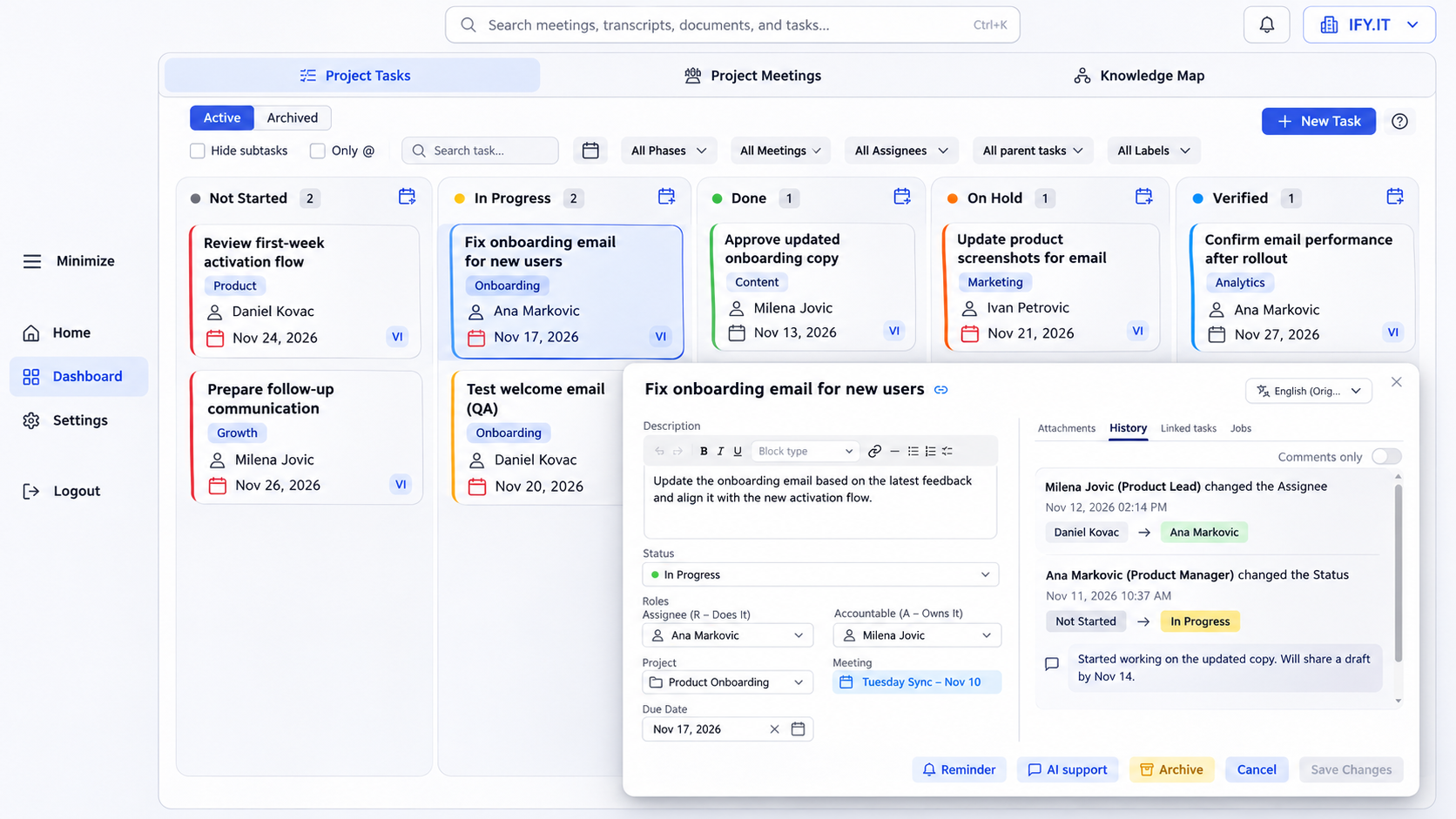
Building Minuteory was my answer to those Tuesdays. We built the handoff into the product instead of leaving it to willpower. When a meeting is processed, the action items are pulled from what was actually said and each one is assigned to a named owner rather than to the room. Behind that owner sits a RACI structure that makes responsibility unambiguous (here is how RACI turns meeting notes into named, accountable owners). Exactly one person is Accountable, the one who owns the outcome, shown as A Owns It. At least one person is Responsible for the work, shown as R Does It, with others advising or kept in the loop. Two people can never both be the owner of the same task, so accountability is never shared into a blur.
Once a task has an owner it stops living only in the meeting. It lands in that person's own list of work with a due date and moves through clear statuses, from Not started to In Progress to Done, with On hold and Verified when needed. Marking a task Done or On hold asks for a short optional comment that stays in the task history, so the reason something changed is kept. The Accountable person can update any task on the project even without content creator access, because the owner of an outcome should never be blocked from reporting on it.
The part that would have saved that onboarding email is the reminder. Each task can carry its own reminder, one time or recurring, and when it fires it nudges the assignee by email and notification, so a commitment no longer depends on anyone remembering the meeting a week later. Across a series of meetings, open tasks carry forward and recurring ones reopen, even across languages, while anything edited by hand is left untouched, so the same item does not silently reset or multiply. When I want to know where one thing stands, I ask about it by name in the assistant and get its owner, status, and due date back. A health indicator on the members view turns green when every project has both a doer and an owner, and goes red, naming the problem, when a project has three owners or one person holding every role. And every Monday the team gets a short digest of the meetings and tasks due that week, so last week's commitments start the new week in front of the people who own them.
A Test You Can Run on Your Own Meetings This Week
Here is the exercise I give anyone who tells me their follow through is fine. Take the single most important thing your team decided in a meeting last week, and before looking at any notes, ask three people who were there the same question separately: who owns this now. One confident, matching answer means your accountability is real. Three different answers, or three versions of I thought it was someone else, is the exact gap this post is about, and it costs you more than that one task.
Then look at where that commitment actually lives right now. Is it in a document that is nobody's job to open, or in a specific person's list of work, with a due date, where it will surface on its own. The distance between those two states is the distance between hoping and knowing, and almost every team I talk to is standing on the hoping side without realizing it.
If that test stung a little, it is worth seeing what the same meeting looks like when the handoff is built in rather than left to memory. Minuteory turns the conversation into action items that each leave the room with one accountable owner, a due date, and a reminder that brings the work back until it is done, so holding your team accountable after a meeting stops being a thing you chase and becomes a thing the system carries. If you want to stop losing meeting action items to the gap between the room and the work, see it on your own meetings at app.minuteory.com.