
What Is a Meeting Decision Log and Why Your Team Needs One
Most teams are not short on meeting notes. They have recordings, transcripts, summaries, shared docs, and a channel where someone posts the recap. What they are short on is a quick answer to a simple question: what did we actually decide, and who is on it?
That is what a meeting decision log is for. It is a running list of every decision your team makes in meetings, each one with the reason behind it, the person who owns it, and the date it was made. Not a record of the conversation. A record of the outcomes.

A Decision Log Is Not the Same as Meeting Notes
Meeting notes tell you what was said. A decision log tells you what changed because of it. That sounds like a small difference until you try to use either one three weeks later.
Notes are organized by meeting. To find a decision, you have to remember which meeting it happened in, open those notes, and read until you hit it. If the topic came up in four meetings, good luck working out which version stuck. A decision log is organized by decision. One line per call, newest on top, and you can scan a quarter of choices in a couple of minutes.
Notes are also written for the people who were there. They are full of shorthand and half-finished thoughts. A decision log is written for the people who were not there: the new hire, the stakeholder who skipped the call, or you in six months, when you have forgotten the details.
Why Decisions Get Lost Between Meetings
Decisions rarely get lost because someone was careless. They get lost because of how meetings work. A decision usually lands in the last few minutes, after a long discussion, when everyone is already thinking about their next call. Someone says "okay, let's go with option B," people nod, and the meeting ends. Nobody stops to write it down in a way that will last.
Then the decision has to survive on memory. Each person leaves with a slightly different version of it. One remembers the decision but not the condition attached to it. Another remembers the discussion but not that it was settled. By the next meeting, the question is open again, and the team spends twenty minutes making the same call it already made. I wrote more about that loop in how to build a meeting decision memory.
The other way decisions get lost is ownership. A decision with no owner is really just an opinion the group happened to share. If nobody is named as responsible for carrying it out, it stays exactly where it was agreed: in the room.
What a Good Decision Log Entry Looks Like
You do not need a fancy template. A good entry answers four questions, and if it answers all four, it will still make sense a year from now.
- The decision. One plain sentence. "We are moving the launch to March 12." Not "discussed launch timing."
- The rationale. Why this, and what you ruled out. "February clashed with the pricing change; the team chose to ship both cleanly rather than overlap." This is the part notes almost always drop, and the part people need most later.
- The owner. One named person who makes sure it happens. Not "marketing." Not "the team." A name. If you want a simple way to keep that clear, here is RACI for meeting accountability.
- The date. When it was decided, and in which meeting, so anyone can go back to the full discussion if they need it.
That is it. Decision, rationale, owner, date. If an entry is missing the rationale, someone will reopen it. If it is missing the owner, nobody will act on it.
How Minuteory Builds Your Decision Log Automatically
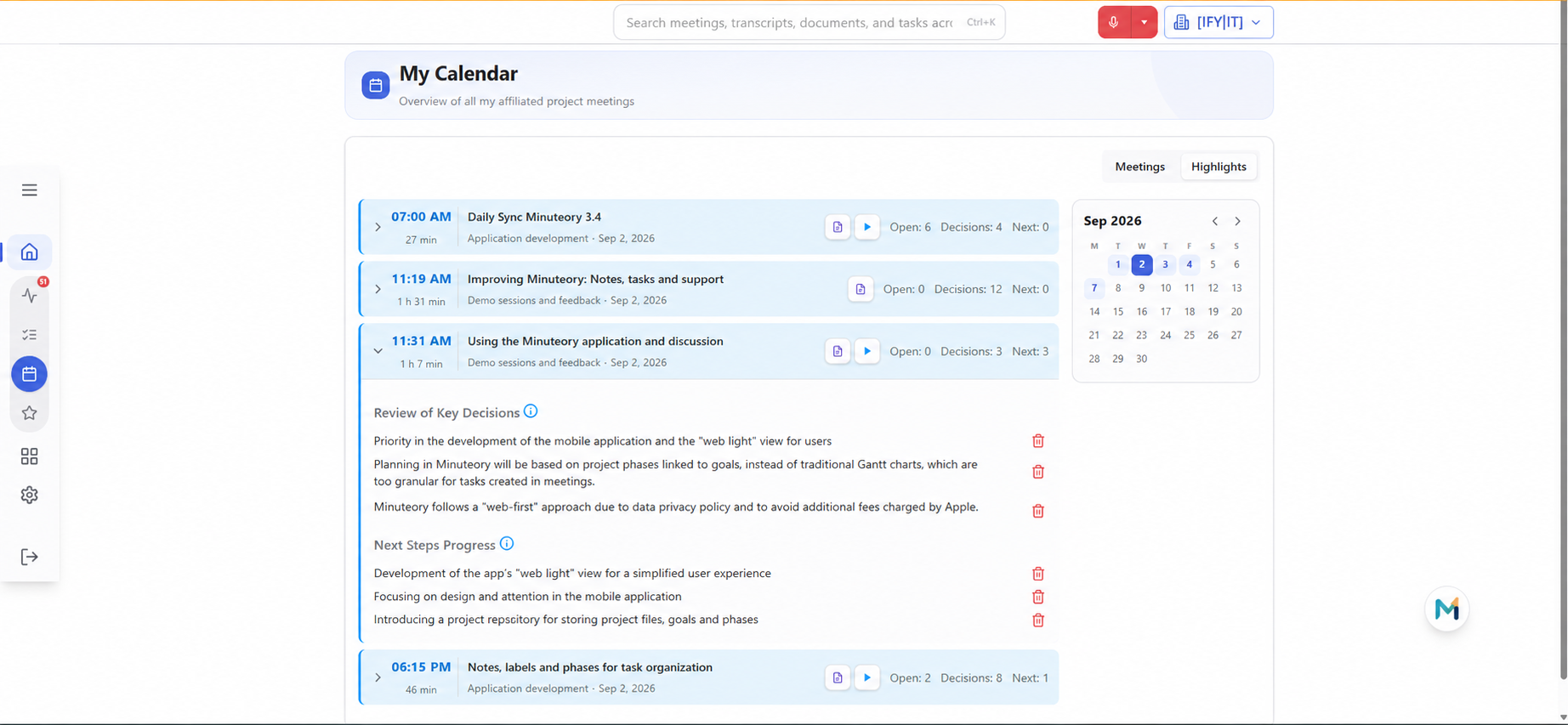
The honest problem with a decision log is upkeep. Everyone agrees it is a good idea, someone starts a spreadsheet, and by week five it is out of date. A log that depends on one organized person stops the moment that person gets busy.
So we stopped asking people to maintain it. When Minuteory processes a meeting, it pulls the decisions out of what was actually said and puts them in the Highlights of that meeting's summary, next to the open questions and next steps. You do not have to dig through a transcript to find what was agreed.
The work that comes out of each decision becomes action items with a named owner, using the same RACI roles, so there is always one person accountable. And because global search covers every meeting in your workspace, "what did we decide about pricing in March?" is something you look up, not something you ask around about.
What Should a Meeting Decision Log Include?
Each entry in a meeting decision log should include four things: the decision itself in one plain sentence, the rationale behind it (including the options that were ruled out), one named owner responsible for carrying it out, and the date and meeting where it was made. Those four fields are enough for someone who was not in the room to understand what was decided, why, and who to ask.
Want to try it? Take the last three decisions your team made and write each one down with those four fields. If you struggle to fill in the rationale or the owner for any of them, you have found exactly the gap a decision log closes. Or let Minuteory build the log for you from your next meeting at app.minuteory.com.