
Why Your Team Keeps Missing Follow Ups After Every Meeting
When I ran delivery at HYCU, the most expensive part of our week was not the meetings. It was the three days after them.
We would leave a planning session feeling aligned. Everyone nodded. The decisions felt clear in the room. Then on Tuesday morning I would open my inbox and start writing the email nobody wanted to receive, the one that asked who was actually handling the thing we had all agreed on. Half the replies came back fast. The other half never came back at all, and by Thursday two people were quietly building the same thing while a third waited for an answer that was never coming.
It took me longer than I want to admit to see the pattern. The problem was never that my team did not care. They cared. The problem was that the moment the meeting ended, the agreement we made in the room started dissolving. Each person walked out carrying their own version of what was decided, and the only place those versions ever got reconciled was that follow up email I sent every week.
That email was not a communication tool. It was a patch over a hole in the system, and patches fail.

What a Meeting Follow Up System Is Actually For
A meeting follow up system has one job. It carries what was decided in the room into the work that happens after it. Most teams do not have a system for this at all. They have a habit, and the habit is the follow up email.
The trouble with the email is that one person writes it, from memory, after the energy of the meeting has already faded. Whatever was actually said gets compressed into the few points that person remembered most clearly. The commitment someone made out loud, in their own words, never reaches the page in the same form. By the time the email lands, it has already become an interpretation, and an interpretation is something people can quietly disagree with without ever realizing they disagree.
This is where accountability goes to die. Not in a dramatic failure, but in the soft gap between what someone heard and what someone else meant. Nobody refuses to do the work. They each do a slightly different version of it, or assume a colleague has it handled. The decision that felt solid on Monday is three different decisions by Wednesday, and the cost does not show up until the rework starts. A few days of parallel effort, a deadline that slips because a handoff never happened, a conversation that has to occur twice because the first version of it was never written down the same way by everyone in the room.

Why Better Notes and More Reminders Do Not Fix It
The usual response to this is to write better notes. Assign a note taker. Use a cleaner template. Send the summary faster. All of that improves the document and changes almost nothing about the outcome, because the document was never the real problem. A better record of an interpretation is still an interpretation.
The second usual response is more reminders. Add a task to a board. Set up a recurring nudge. The reminder tells you that something is due, but it does not tell you that you and your colleague understood the commitment differently in the first place. It enforces a version of the truth that may already be wrong.
The third response is to hold another meeting. A status meeting to check on the work the last meeting was supposed to set in motion. This is the most expensive option of all, because it treats a documentation failure as if it were an attention failure. The team did not forget. They were never working from the same record. A well designed process can hide this for a long time, and that is the trap. When every miss gets explained as the process not being clear enough, accountability has somewhere to hide. The thing that fixes it is not a better meeting format. It is a record that makes the commitment visible and hard to reframe before anyone leaves the room.
How Minuteory Builds the Follow Up System Into the Meeting
The reason I ended up building Minuteory is that I got tired of being the reconciliation layer for my own team. I wanted the record to come out of the meeting itself, not out of my memory on a Tuesday morning.
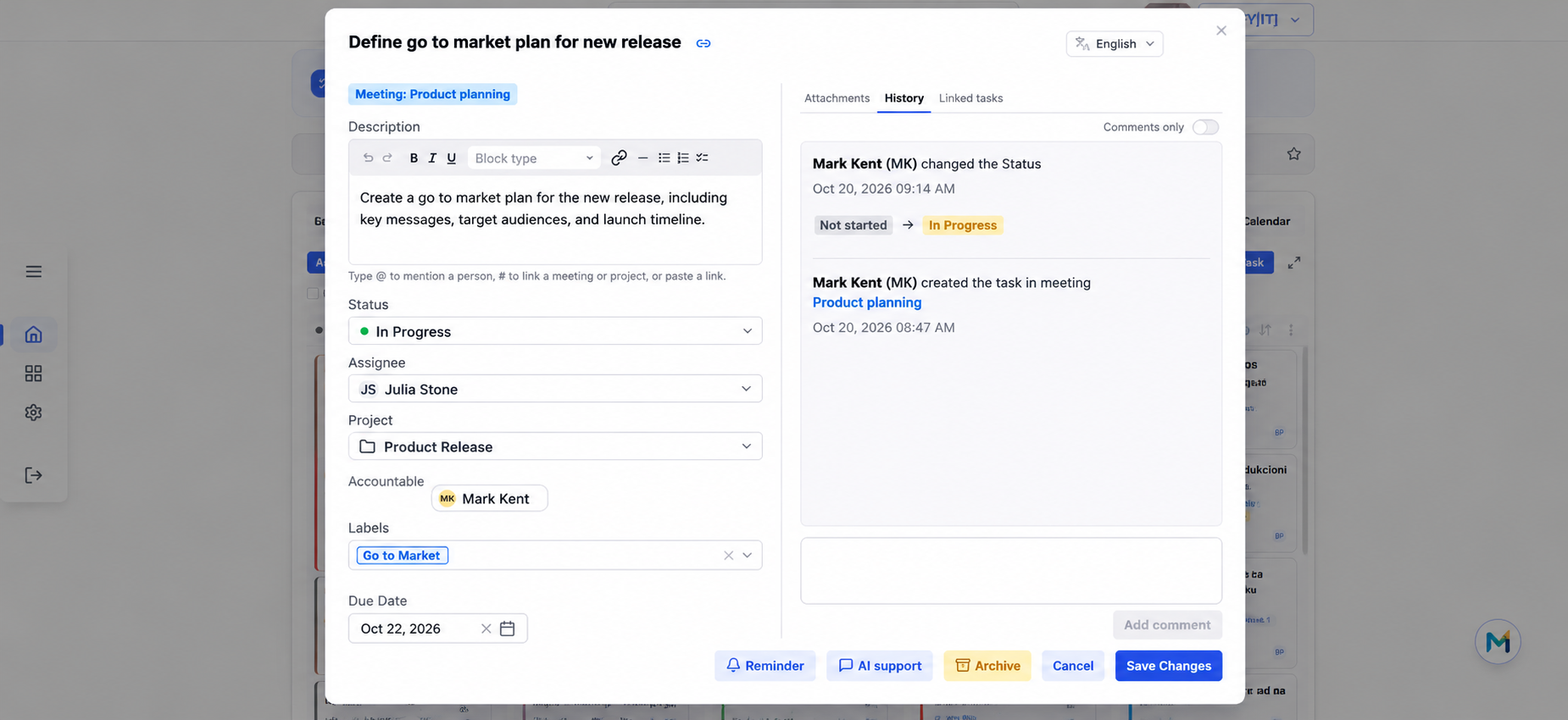
So that is what it does. Minuteory captures the meeting and generates the summary, but the part that mattered most to me is what happens to the commitments. It extracts the action items directly from the conversation and turns them into tasks, each with a named owner attached. Not a vague we should, but a specific task tied to a specific person. Every task carries a RACI role, so the meeting does not just record who will do the work. It records who owns the outcome, who advises, and who needs to stay in the loop. The person who does it and the person accountable for it stop being the same blurred idea.
After the meeting, nobody is waiting on my email. Each person opens their own My Tasks view and sees exactly what they own across every project, with a due date that turns red the moment it slips. When a task is assigned, the owner is notified. The reconciliation I used to do by hand already happened, automatically, before anyone left the call. There is no follow up email because there is nothing left to reconstruct.
On top of that, every meeting is scored across six effectiveness dimensions, including Outcome Orientation and Personal Performance, so over time I can see whether our meetings are producing owned outcomes or just producing more meetings. That visibility is the thing I never had when I was the one sending the Tuesday email.

Run This Follow Up Audit This Week
Here is a test you can run this week without changing any tools. Go back through your last five meetings and count two things. First, count how many follow up messages you or someone on your team sent afterward that existed only to clarify who owns what. Second, for each of those meetings, take one decision and ask two people who were in the room to write down, separately, what was agreed and who is doing it. Then compare the two answers.
If the follow up messages are frequent, your team does not have a meeting follow up system. It has you. And if the two written answers do not match, you have just found the exact place where next week's rework is going to come from. The gap is not in anyone's effort. It is in the handoff between the room and the work, and that gap is the one thing here that is actually fixable.
Stop Being Your Team's Reconciliation Layer
If you are the person who sends the Tuesday morning email asking who is handling the thing everyone already agreed on, you are doing a job that should not exist. Let the record come out of the meeting instead of out of your memory, with a named owner on every task before anyone leaves the room. Run your next meeting through it at app.minuteory.com.