
Meeting Performance Tracking Tool: Score Every Meeting on Six Dimensions
We had been running the same Monday planning meeting for almost a year before I realised I could not answer a simple thing about it. Someone asked me, near the end of a long week, whether those Mondays were working better than they used to. I opened my mouth to say yes, and then I stopped, because I had nothing to point to. I knew it still ran about an hour. I could not say whether the meeting we ran in November was any sharper than the one we ran the previous January.
What I had was a feeling, and the feeling was not a good one. The meeting felt heavier than it used to. More people, more status updates, fewer decisions that actually held. But a feeling is not something you can manage. I could tell you how many meetings we held and how many minutes they ate out of the week. Our meetings, which took more of the team's week than any one project, were the one thing we ran on instinct. If a founder cannot see whether the team is improving at the work it spends the most time doing, that is the most expensive thing in the calendar going unwatched.

Why You Cannot Manage Meeting Performance You Never Measure
The reason that question caught me out is that meeting performance is invisible by default. The two things that are easy to capture, how many meetings you hold and how long they last, tell you about the cost of meetings and nothing about their value. You can watch your calendar fill up and your hours drain away and still have no idea whether any of those hours produced a clear decision, a real owner, or a next step that someone actually took.
So most teams fall back on memory, which is a terrible instrument for this. It keeps the loud moments and loses the pattern. The slow drift, where a meeting gets a little vaguer and a little longer every month, is exactly what memory cannot catch, because no single session feels different from the one before it. By the time the decline is obvious, it has been running for half a year.
Why Calendar Analytics and Surveys Miss Meeting Performance
The usual attempts to fix this measure the wrong thing. Calendar and time analytics count meetings, tally hours, and show who sits in the most of them. That is accounting, not performance: it describes the container, never the contents. Two meetings of the same length and headcount can be worlds apart in quality, and a tool that only sees the calendar cannot tell them apart.
The other common answer is the post meeting survey, the one that asks everyone to rate how the meeting went. The problem is the obvious one. Hardly anyone fills it in, the people who do are rating a mood rather than an outcome, and a number that arrives once and never repeats tells you nothing about whether things are improving. The honest answer to how to measure meeting effectiveness comes from the meeting itself, from what was actually said, decided, and assigned, and those meeting effectiveness metrics have to be produced the same way every time so you can compare this week against last. That is the gap no calendar tool and no survey closes, and it is the gap a meeting performance tracking tool exists to fill.
How a Meeting Performance Tracking Tool Scores Every Meeting
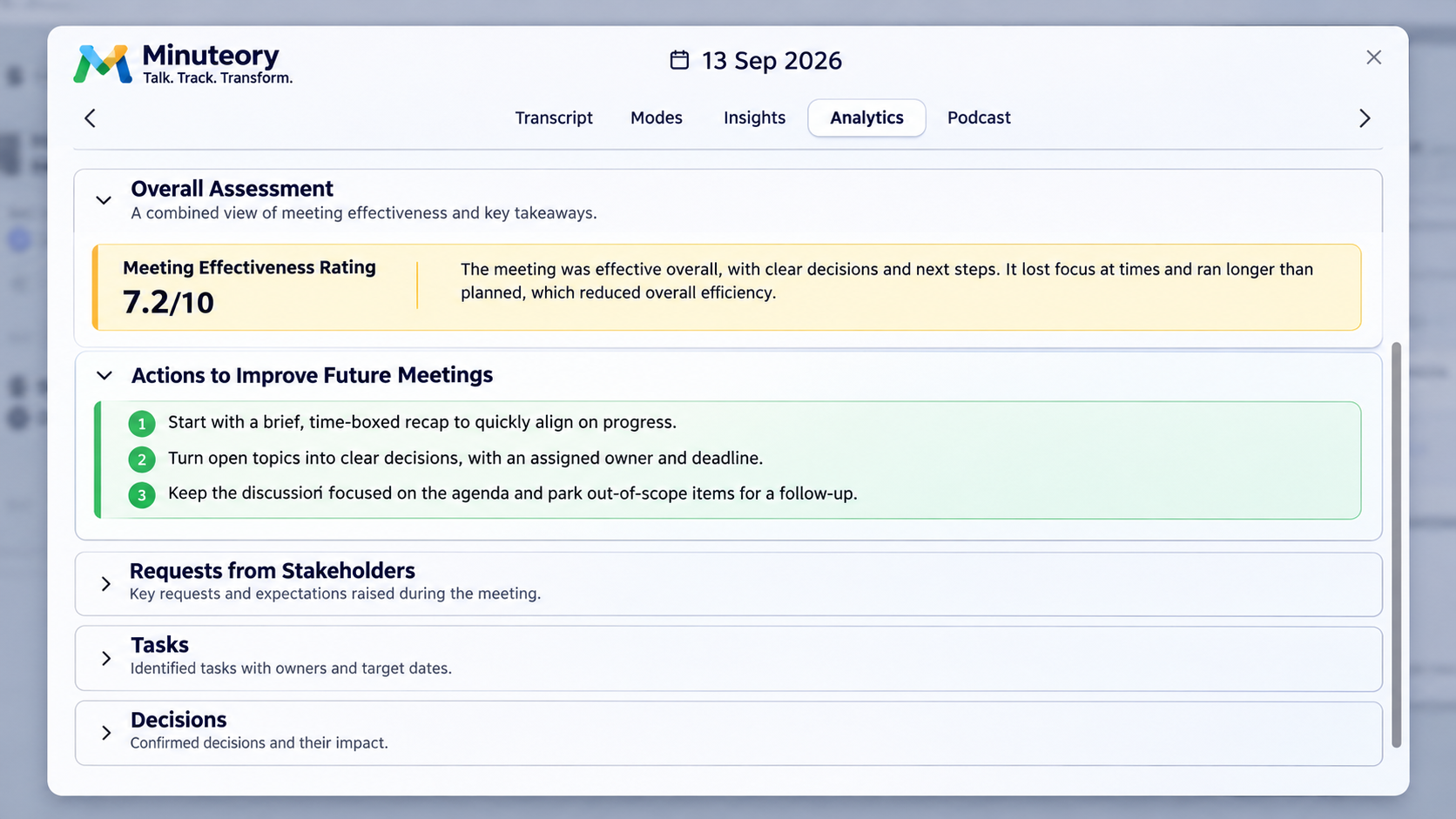
This is the part of the problem that pushed us to build it into the product. A meeting performance tracking tool does not watch your calendar. It reads the meeting. Minuteory takes the transcript of what was actually discussed and scores that meeting across six fixed dimensions, the same six every time, so the result is comparable from one session to the next.
The six dimensions are Purpose Clarity, which asks whether the meeting had a defined goal and agenda in the first place; Participant Engagement, which looks at whether the right people were there and whether all of them were actually heard; Outcome Orientation, which checks whether the conversation produced concrete decisions and next steps or just talk; Personal Performance Suggestions, which gives role specific feedback including how people held their RACI roles; Meeting Analytics, which breaks down topic distribution and how the speaking was shared; and Overall Assessment, which pulls all of it together into a Meeting Effectiveness Rating, a single score out of ten with a written explanation of why the meeting earned it. That rating is the closest thing to the AI meeting quality score teams keep asking me for: it is produced automatically from the meeting content, not from anyone's opinion afterward.
The scoring is configurable by meeting type, because a weekly standup, a client review, and a board session should not be judged the same way. An organisation can turn individual dimensions off or define its own for each type. The point is consistency: every meeting of a given type is scored against the same frame, so the number means the same thing each week.
What a Meeting Performance Tracking Tool Shows You Over Time
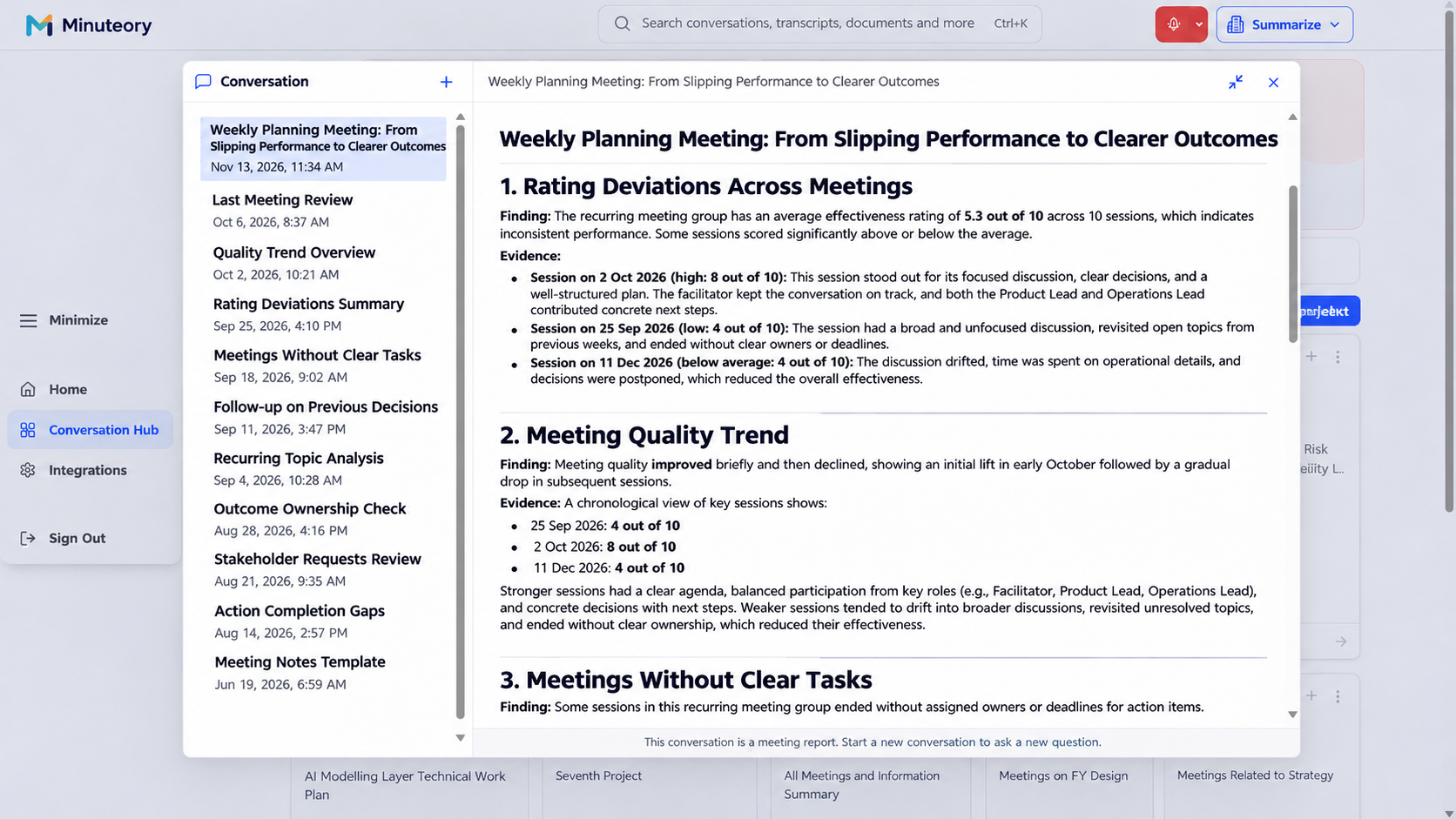
A score on one meeting is interesting. A score you can watch move is what answers the question I could not about our Mondays. When you group a recurring meeting as a connected series, Minuteory generates a report on the whole group, and that report is where meeting performance stops being invisible. It carries a Quality Trend that reads the pattern of quality across the group over time, Rating Deviations that flag which individual sessions scored above or below the group average, a check for meetings that produced no clear tasks, a view of whether decisions from earlier sessions were followed up, and a flag for topics that keep coming back without ever resolving.
That last one was the quiet killer in our Monday meeting, and I only saw it once the tool named it: the same two subjects reappearing week after week with no progress, the signature of a meeting that feels busy and achieves little. This is meeting analytics drawn straight from what the team said and did, assembled into a trend a founder or an operations lead can read in a minute. For the fuller picture of how that movement looks across a quarter, we wrote about it separately in how meeting quality moves over time.
A Test You Can Run on Your Next Recurring Meeting
Here is the exercise that convinced me this was worth building, and you can run it this week without any tool at all. Take one meeting you hold on repeat, the one that has been on the calendar longest. Now try to answer, from memory, whether its last four sessions scored better or worse than each other on three things: did each one start from a clear purpose, were the right voices actually heard, and did each one end with concrete owned outcomes. Write down your honest answer for each session.
Most people cannot do it. They can describe the most recent meeting and maybe the worst one, and the rest is fog. That fog is the finding. If you cannot reconstruct how your most important recurring meeting has performed over its last month, you are not managing it, you are attending it. Scoring every session the same way turns that fog into a line you can see, and a line is something you can bend.
People ask me a few things here. How do you measure if a meeting was productive. You measure it on what it produced, clear purpose, real engagement, and owned outcomes, scored the same way every time, not on how it felt. What is a good meeting effectiveness score. Less important than the direction: a seven that is climbing beats a nine that is quietly sliding. Can you score meetings automatically. Yes, which is the only reason this is practical, because a score you have to assemble by hand is a score nobody will keep.
Start Seeing Whether Your Meetings Are Getting Better
The meetings you run every week are the biggest recurring investment your team makes, and most companies cannot tell whether it is paying off more than it did a year ago. A meeting performance tracking tool turns that from a feeling into a number you can watch, meeting by meeting and trend by trend, so you can finally answer the question I could not. If you want to see what your own recurring meetings score, start at app.minuteory.com.