
How Consultants Manage Meeting Accountability Across Multiple Clients
The first time I nearly sent one client the action items from another client's meeting, I was three calls deep into a single afternoon. Different company, different project, different set of names, and by the third call they had started to blur. The notes lived in three different places. The commitments I had made sat in my head under three different contexts. I caught the mistake before it went out, but the fact that I could make it at all told me something. The work of running meetings for more than one organization is not the meetings. It is holding each one apart from the others.
Anyone who consults, runs an agency, or manages accounts knows this shape. You are not a member of one team with one set of recurring meetings. You move between organizations all day, and each one expects you to remember exactly what was decided, who owned it, and what you promised last time. The capture is the easy part. Keeping the accountability straight across all of them is the part that quietly eats your evenings.
That is the problem this post is about. Note taking has become a commodity, available inside every tool your clients already use. The thing that is still hard, and still unowned, is accountability that stays separate and correct across many client organizations at once.
Why meeting software for agencies and consultants keeps breaking down
Most meeting tools are built for a person who lives inside one company. One workspace, one team, one set of projects. The moment you work across several clients, that assumption starts to cost you. Either you keep everything in one place and the boundaries blur, or you spin up a separate tool per client and lose any single view of what you owe whom.
The blurring is the dangerous version. When notes, tasks, and decisions from four clients share one undifferentiated space, the risk is not just embarrassment. It is confidentiality. One client's roadmap detail pasted into another client's follow up is the kind of error that ends an engagement. The separate tool version is safer but slower. You log in and out, you rebuild context each time, and you still cannot answer the simple question a consultant lives or dies by: across everyone I work with, what is open, what is late, and what did I commit to.
How to keep meeting accountability across multiple clients separate and correct
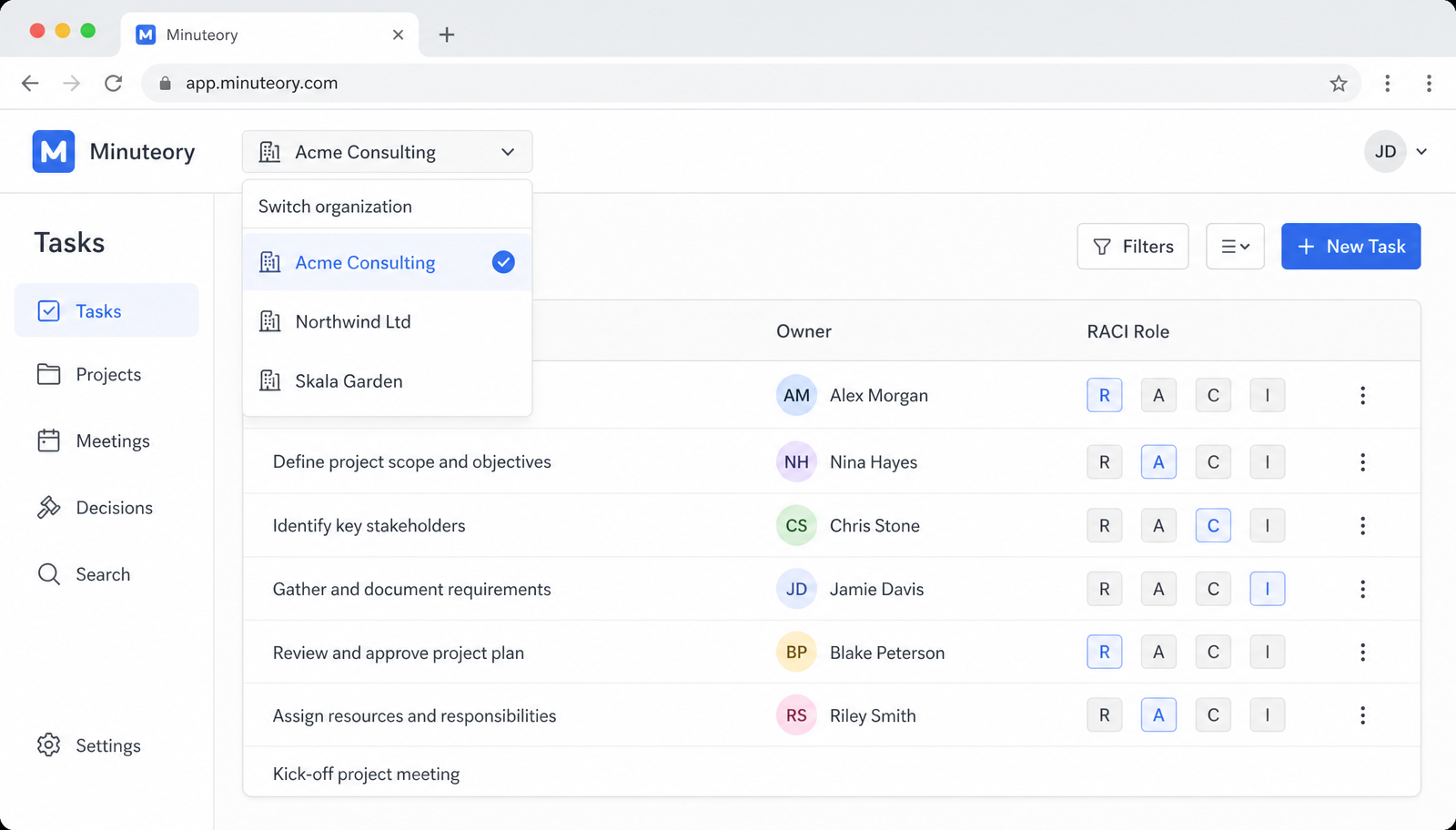
Minuteory is built around multi organization support rather than a single team. Each client can be its own organization, fully independent from the others. Projects in one organization do not touch projects in another, and the organization switcher in the top corner makes clear which client context you are in at any moment. When you switch organizations, the search and the data narrow to that client automatically, so you are never looking at one client through another client's window.
That separation is what makes the accountability trustworthy. Inside each organization, every meeting produces tasks with named owners and how RACI assigns a named owner to every meeting task, so a spoken commitment becomes a tracked item with exactly one person accountable for it. Because you are a member of every client organization you work in, the Home page can show your tasks across all of them in one place, while each task still carries the project and workspace it belongs to. You get the single view of everything you owe without the contexts leaking into each other.
There is one more piece that matters for client work specifically. You can bring a client into a project as an external user with view only access to just that project, not to anything else in your world. The client sees the decisions and the accountability for their own engagement, in their own organization, and nothing beyond it. The boundary that protects you is the same boundary that reassures them.
Switching between clients is where most of the daily risk lives, and it is the part the organization switcher is built to remove. The moment you move from one client to another, the whole application changes context with you. Search stops returning the client you just left. The projects, the tasks, and the meetings all belong to the organization you are now in. You are not relying on your own tired attention to keep the wall up between two engagements at five in the afternoon. The product keeps it up for you, on every switch, which is exactly the moment a busy consultant is most likely to make the mistake that ends an engagement.
What good multi client meeting management actually looks like
The point of all this is not tidiness. It is that a consultant who can show a client exactly what was decided, who owns it, and whether it is on track is a different kind of vendor than one who sends a document after the call. The accountability layer becomes part of how you are perceived. You stop being the person who took good notes and start being the person nothing falls through with.
It also changes how you carry the load between meetings. When every client organization is separate but every task you own rolls up into one view, you no longer keep the whole portfolio in your head. The system holds the separation and you hold the relationships. That is the trade that makes working across many clients sustainable rather than exhausting.
There is a commercial edge to this as well. Renewals and referrals rarely turn on the quality of a single deliverable. They turn on whether the client felt in control of the engagement the whole way through. A client who can open their own view and see every decision, every owner, and every open item is a client who trusts the process, and trust is what gets a contract extended and a name passed to the next prospect. The accountability layer is not back office hygiene. It is part of how the work is won and kept.
A test you can run this week across your clients
Take the last two weeks of meetings across every client you serve. For each one, try to name from memory the open commitments you personally own and the ones your client owes you. Write them down fast, then check them against what was actually agreed. Most people who run meetings for more than two organizations find at least one commitment they had lost track of entirely, and usually one they had mentally attached to the wrong client.
That exercise is uncomfortable on purpose. The commitments you cannot reconstruct are the ones a client will eventually remember for you, at the worst possible moment. If keeping them straight depends on your memory holding four contexts at once, the failure is only a matter of time. The fix is not trying harder to remember. It is a place where each client stays separate and every open item stays visible.
Where the separation becomes trust
Running meetings for one team is a note taking problem. Running them for many is an accountability problem, and it is the one your clients feel. If you want to see what it looks like to keep every client organization separate while every commitment stays in one view you can trust, you can set it up for your own client work at app.minuteory.com.