
Meeting Decision Tracking: Stop Deciding Things Twice
Three months into a new role, a person asks why the team chose the current pricing structure. Everyone knows what the structure is. Nobody can explain why it was chosen, because the meeting where it was decided happened in March, the notes are in a folder nobody opens, and two of the people in the room have since left. The explanation the new person gets is a reconstruction from memory, partial and slightly different depending on who they ask.
That conversation has happened in almost every team I have been part of. Not because the original decision was wrong or the people in the room were careless. Because a meeting produces two things: a resolution and the reasoning behind it. The resolution survives in a document or a slide or a process. The reasoning disappears the moment the call ends. And disappearing is a polite word for it. It was never written anywhere that would survive the next quarter.

What Gets Lost When Meeting Decisions Go Untracked
A decision and the reasoning behind it are not the same thing, but they are usually stored as if they were. The team records what it decided. The minutes say the pricing structure was changed. What the minutes do not say is that three alternatives were considered, that one was ruled out because of a conversation with a customer two weeks prior, and that the decision was explicitly revisited once and confirmed. That context is the part that matters six months later, when someone new is trying to understand the product and asks the question that sends everyone looking at each other across a call.
The same gap is why teams decide the same thing twice. A direction gets set. The reasoning behind it lives only in the memories of the people who were in the room. Time passes, the team changes slightly, the question comes up again in a meeting where half the room was not present for the original call. The reasoning is not accessible, so the team works through the same ground and arrives at the same place, or sometimes somewhere different, without realizing either has happened before. Meeting decision tracking is not a productivity question. It is a continuity question. Who decided what, why they decided it, and whether that reasoning is still visible to the people who need to act on it. Decades of management research on decision roles make the same point, that organizations move faster when it is clear who decided and on what basis, not only what was finally decided.

Why Most Teams Have No Real Meeting Decision Tracking
The common response to this problem is to write better notes. Record the call. Circulate a follow up. Use an AI tool that produces a summary. All of these help with the surface layer, the what, and none of them reliably solve the why, or the later.
A summary is a static document produced once and never opened again. The decision is recorded on the day. Two months later, when the question comes up in a different meeting, no one is going back to the August summary to find it. A manual decision log depends on someone maintaining it consistently, which means it reflects whoever was most organized that quarter and then stops. And even the best written note loses context as the team changes, because the note cannot tell a new person which alternatives were ruled out, what the mood in the room was, or whether the call was close.
The problem is not capture. Notes and summaries and recordings already do that. The problem is that capture and memory are being treated as the same thing, and they are not. A decision stored in a document that nobody will look at has not been preserved. It has been filed.
How Minuteory Handles Meeting Decision Tracking
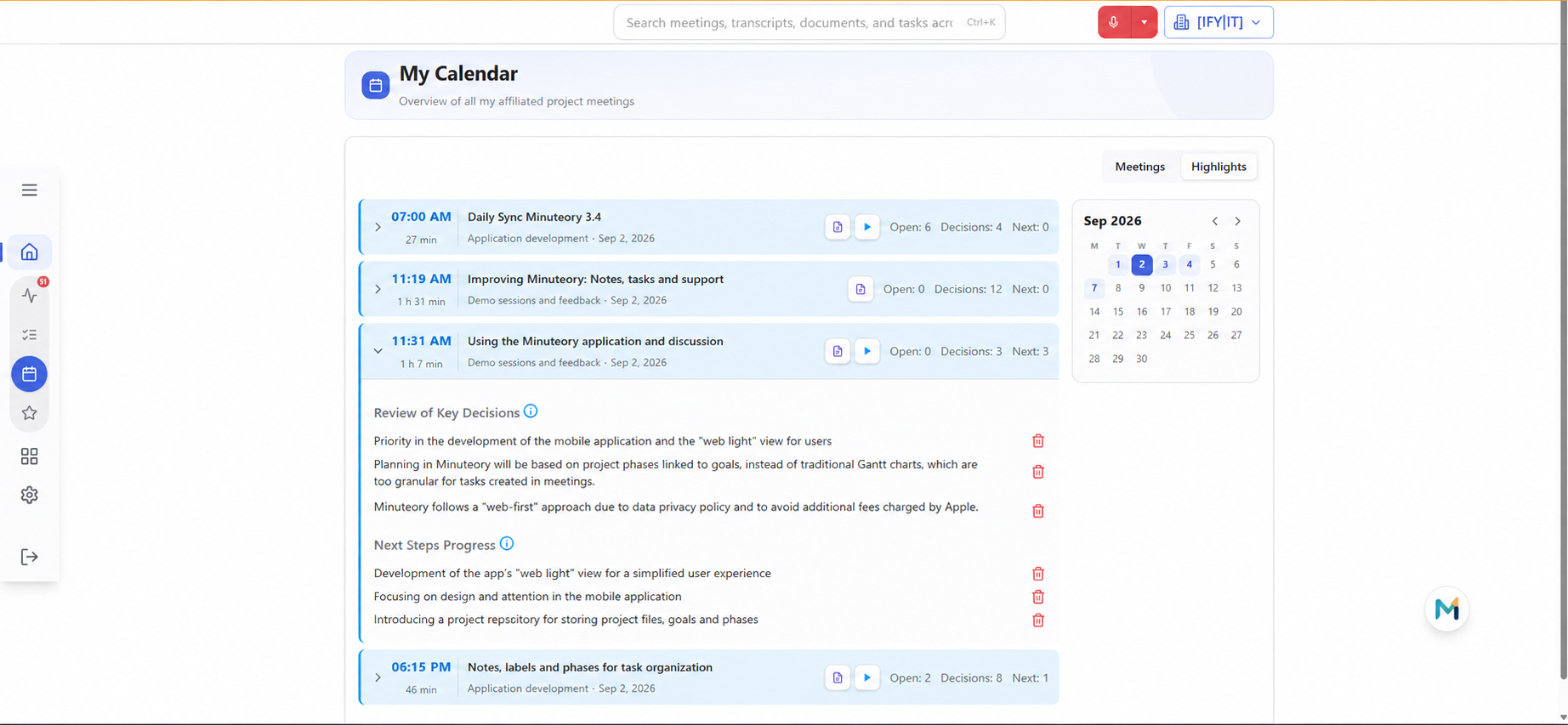
This is the gap I built Minuteory around, because I kept watching the same decision get made twice inside teams that thought they had good records. Minuteory extracts decisions from every meeting and surfaces them in the Highlights of that meeting's summary, alongside the outstanding questions and next steps that came out of the same conversation. The decision is not buried in a wall of transcript. It sits in its own section, visible the next time anyone opens that meeting.
The layer that makes this useful over time is Meeting Threads. When your weekly standup or your monthly review is connected into a thread, each meeting in that series builds on the record of the previous ones. The context accumulates in one place rather than scattering across separate notes in separate folders. A person joining the team three months in can open the thread and move through the connected meetings to understand not just what was decided but how the thinking evolved and what was considered along the way. That is a different kind of access than handing someone a summary document and hoping they find the right paragraph.
When a question comes up again in a later meeting, what your meeting AI does after it writes the summary matters as much as the summary itself. A summary that lives in isolation does not help anyone who was not in the room. A meeting connected to a thread, with its decisions visible in the Highlights and its reasoning carried forward across the series, does. The global search in Minuteory spans every meeting in your workspace, so the answer to "what did we decide about pricing in March" is a search away rather than a conversation with whoever has the best memory. And for every action item that came out of the decision, assigning a named owner to every action item the decision creates is the next step that turns a decision into something that actually moves.
The Test You Can Run on Your Last Three Major Decisions
Here is a simple check worth running this week. Take three significant decisions your team made in the last six months. For each one, ask whether a person who was not in the meeting that day could, right now, find out what was decided and why. Not by asking someone. By looking.
Count how many of the three have an accessible record of the reasoning, not just the outcome. If most of them do not, you do not have a records problem. You have a continuity problem, and it will get more expensive as the team grows and the decisions compound. The good news is that it is a structural problem, which means it has a structural fix.
Where This Leaves the Next Person Who Asks Why
Every team eventually gets asked why it decided something. The question comes from a new hire, from a stakeholder who was not in the room, from the team itself six months later when circumstances have changed and the decision needs to be revisited. The teams that answer it well are not the ones with the best memories or the most diligent note takers. They are the ones where the reasoning was captured in the moment and kept somewhere it would still be findable. If you want to see what that looks like in practice, start at app.minuteory.com.