
Meeting Action Item Accountability: From Conversation to Confirmed Task
At the end of a strategy session that ran ninety minutes, I had eight commitments written in my notebook and a clear sense of who had taken each one. I closed my laptop confident the team knew what came next. Two days later, two of those commitments had been done by people I did not think had agreed to them. One had been done twice. Three had not been started, and the people I believed owned them had a different memory of the meeting than I did.
Nobody had failed at their job. What failed was the quiet moment in every meeting when a spoken commitment is supposed to become a tracked task, and simply did not. Inside the room it looked like the work had been assigned. Someone said they would handle it, someone else nodded, a name got written on the back of a notebook. From the outside that looks like accountability. From the inside almost nothing had actually been confirmed.
This post is about that specific gap, the one between a conversation and a confirmed task. It is not the note taking problem. Capturing what was said is a solved and commoditized thing now. The unsolved part is making sure every commitment leaves the room attached to a person who knows they own it.

Why meeting action item accountability breaks at the moment of handoff
A meeting produces two kinds of output. There is what was discussed, which tools capture well, and there is what someone now has to do, which they mostly do not capture at all. The second one is fragile because it depends on a transition that happens in a fraction of a second and is never written down at the time. A person says "I can take that." Whether that sentence becomes real work depends entirely on what happens in the minutes and hours after the call, and by then everyone has moved on to the next thing.
Native meeting tools have started to help here, but only halfway. The newer note takers will surface a list of suggested next steps at the bottom of the summary. The problem is that a suggested next step is not owned by anyone. It sits in a document nobody is accountable for. It does not know who is responsible, it does not appear in that person's own list of work, and it does not come back around if it is ignored. A list of tasks with no owners is not accountability. It is a nicely formatted way of hoping.
How AI task extraction turns a conversation into a confirmed task
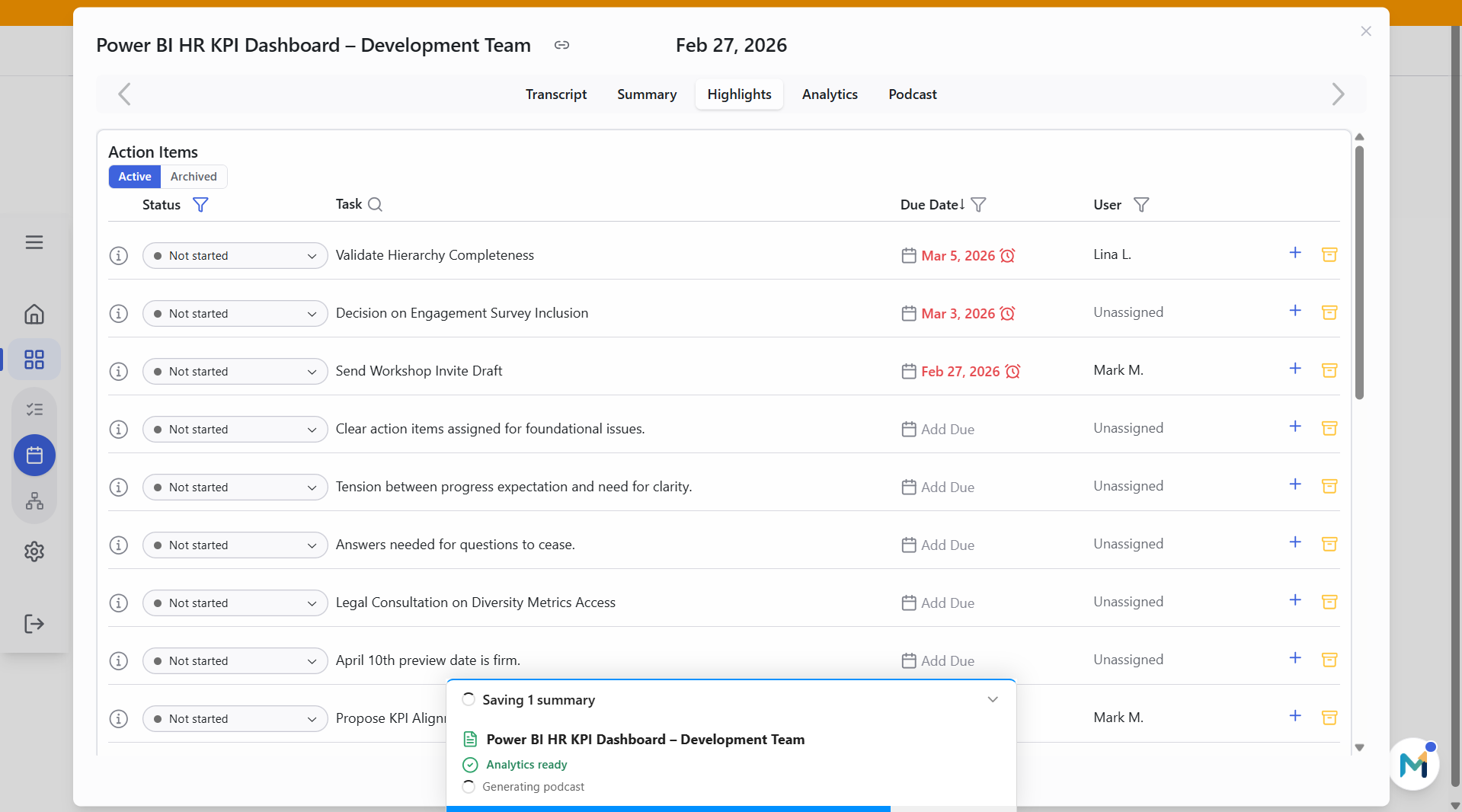
Minuteory treats the handoff as the important moment rather than an afterthought. When the transcript is processed, the tasks are extracted from what was actually said and each one is assigned to a named owner, with RACI roles behind it. The RACI framework is what makes the ownership unambiguous, which is exactly how RACI assigns a named owner to every meeting task. Exactly one person is accountable for each task, the person who owns the outcome and gets the call if it slips. Others can be responsible for doing the work, consulted, or kept in the loop, but accountability is never shared into vagueness.
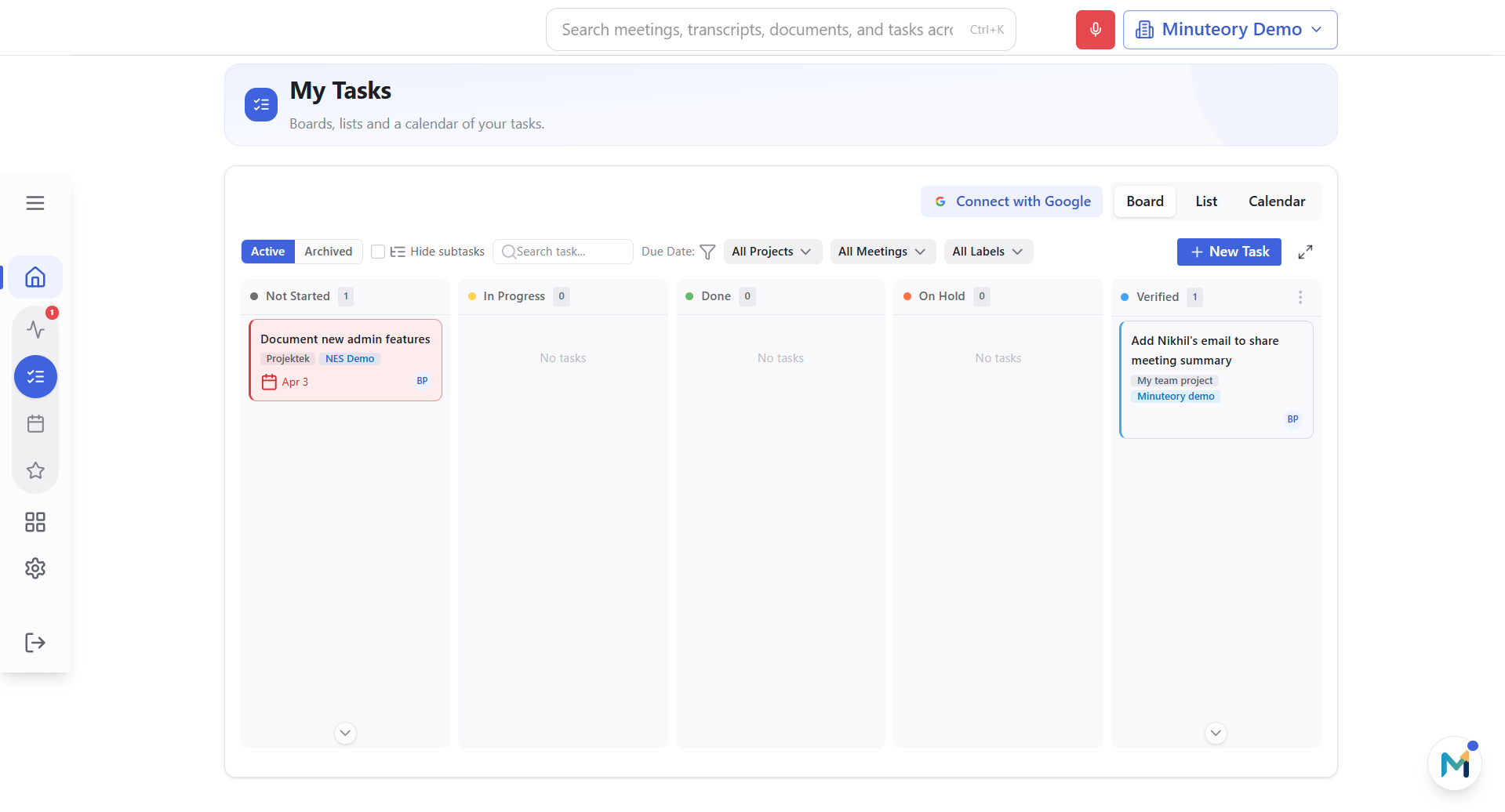
Once a task exists with an owner, it stops living only in the meeting. It shows up in that person's My Tasks view, which gathers everything assigned to them across every project and workspace in one place. The task carries its own due date, and an overdue date is shown in red so it cannot quietly disappear. The person who owns it does not have to remember the meeting to remember the work. The work found them.
The notification matters as much as the assignment. When a task lands on someone, they are told, so ownership does not depend on them having stayed sharp at minute fifty of a long call. And because the due date travels with the task, an owner does not just know that something is theirs, they know when it is due and can watch it turn red the moment it is late. The commitment stops being a thing people are supposed to keep in their heads and becomes a thing the system will not let them quietly lose.
That is the difference between a summary and a system. A summary tells you what was said. Task extraction with named owners tells each person what they now hold, and keeps holding it in front of them until it is done, which is the same distinction behind what your meeting AI does after the summary.
What changes when every commitment has a name on it
When commitments leave the room already owned, the follow up email stops being a second meeting where everyone renegotiates what was decided. There is nothing to reconstruct. The record of who owns what was made at the moment of the meeting, from the meeting itself, not from your memory forty hours later. The conversations that used to happen two days after a meeting, the ones that start with "wait, I thought you were doing that," mostly stop happening.
It also changes what leadership can see. A pile of unowned notes tells you nothing about whether a team is executing. A set of owned tasks with due dates tells you exactly where things stand, who is carrying what, and where the work is stuck, without anyone having to chase it into being visible.
There is a cultural effect underneath this too. When ownership is explicit and visible, the team stops leaning on the single most conscientious person to silently carry everything that was only half assigned in the room. Accountability that used to live in one person's sense of responsibility now lives in the record, where everyone can see it equally and no one is quietly holding the whole thing together. That is healthier for the team and far more durable than depending on someone remembering, every week, what everyone else agreed to do.
A test you can run after your next meeting
After your next meeting that produced real work, wait one hour, then write down every task you believe was agreed and who owns each one. Do it from memory, before you look at anything. Then compare your list against what the people in the meeting think they agreed to. The gap between those two lists is your current meeting action item accountability, measured honestly.
Most people are surprised by how wide it is after only sixty minutes. A commitment you were sure about turns out to be owned by nobody, or by two people who each assumed the other had it. That gap is not a discipline problem you can fix by trying harder to remember. It is a structural gap between the conversation and the task, and it closes only when the handoff itself is captured and owned. The point of the exercise is not to feel bad about the gap. It is to notice that willpower has never been the fix, because the failure happens in the one second nobody is writing anything down, and no amount of good intentions reaches back into that second.
Where a commitment becomes work
A meeting is only worth the work it actually sets in motion. If you want to see what it looks like when every commitment leaves the room with a named owner and lands in that person's own list of work, you can try it on your next meeting at app.minuteory.com.