
What Is Meeting Intelligence? How Your Team Meets, Not Just What Was Said
A few years into running Minuteory, I sat in a review where we had everything. The meeting had been recorded. The transcript was clean. The summary was in the channel before anyone had left the room. Somebody even had a highlight reel of the key moments. By every measure people use to judge a meeting tool, we were fully covered.
Then a client asked a simple thing. She wanted to know who owned the migration task we had agreed on the week before, and whether it had actually moved. I opened the summary. It listed the decision. It named the migration. It did not tell me who owned it, and it did not tell me whether a single step had been taken. We had a perfect record of a conversation and no idea what the conversation had produced.
That was the moment the category clicked for me. We did not have a notes problem. We had drowned ourselves in meeting data and starved ourselves of any read on how we actually worked. The recording, the transcript, the summary, all of it described what was said in one meeting. None of it told us how this team met week after week, what kept coming back unresolved, or who was quietly carrying every commitment. It described single meetings. It could not read the pattern.
I have watched that same gap open in dozens of teams since. The tooling gets better every year at capturing the room. It gets no better at answering the two questions that actually matter once the room empties, which are how this team meets over time and whether anyone is going to do the thing everyone agreed to.

What Is Meeting Intelligence?
Meeting intelligence is the practice and the software of reading how a team meets over time, not just recording what was said in one meeting. A recorder answers what was said. A summary answers what it roughly meant. Meeting intelligence answers what neither of those can reach from a single session, which is what the pattern across a series of meetings is telling you and whether the work those meetings create is actually getting done.
The honest version of the definition has to concede something first. Recording a call is a commodity now. So is transcribing it. So is generating a summary that reads well. Those capabilities were remarkable a few years ago and they are table stakes today. If a definition of meeting intelligence stops at capturing one meeting, it is describing a feature that every tool in the market already ships, and it is not worth building a category around.
So the definition worth using starts where capture ends and widens past the single meeting. Meeting intelligence, in the sense that actually changes how a team works, reads a recurring meeting as a series rather than a set of unrelated events. It sees which topics keep coming back without resolution, how the time a team spends in meetings trends week over week, and where commitments are changing hands or stalling. It is the difference between a faithful account of one conversation and a working picture of how an organization actually meets.
Accountability is where that picture gets sharp. Reading the pattern is only useful if you can also answer, for every commitment the pattern surfaces, who owns it and whether it closed. So meeting intelligence folds in the accountability layer. It extracts from each meeting who committed to what, by when, and to whom, names a single accountable owner, and carries that commitment forward until it is done or explicitly dropped. The pattern shows how the team meets. The accountability loop proves what those meetings are actually producing. Everything else in this post follows from holding those two together.
Why Traditional Meeting Intelligence Falls Short
Most products sold under this banner are built around a single assumption, which is that the bottleneck is capture. Get a cleaner transcript, a smarter summary, a faster recap, and the meeting problem is solved. I believed a version of this myself in the early days. It is a comfortable belief because capture is measurable. You can show a customer a tidy summary and they nod.
The trouble is that capture was never the real bottleneck. I have never once heard a team say their meetings failed because the notes were not detailed enough. I have heard, constantly, that nobody was sure who owned the follow up, that the same decision got relitigated three weeks later, that a task everyone assumed was moving had not been touched. Those are not capture failures. They are accountability failures, and a better transcript does nothing for them.
Traditional meeting intelligence falls short in three specific ways, and the first is the one the category talks about least. It sees one meeting at a time. Each session is processed as an island, so there is no pattern across a recurring series, no sense of whether the weekly sync is improving or decaying, and no visibility into which topics keep returning unresolved or how much time the meetings are quietly consuming. On top of that blindness to the pattern, it has no accountability loop, so a commitment made in the room has no single owner attached and no path to completion. And it has no clarity about who is answerable, so several people leave a meeting each believing someone else has the task, which means no one does.
The result is a strange kind of abundance. Teams have more meeting data than they have ever had, and less confidence than ever about what their meetings produce. More recording, more summarizing, and more searchable text do not add up to more accountability. A category that keeps competing on capture is optimizing the part that was already solved.

Meeting Intelligence vs Meeting Analytics vs Meeting Notes
These three terms get used as if they were the same product, and the confusion is worth clearing up, because each one answers a different question.
Meeting notes answer what was said. They are the record: the transcript, the summary, the list of points raised. Good notes are necessary and they are the raw material for everything above them, but on their own they are a description, not an instrument. A team can have flawless notes and still not know what to do on Monday.
Meeting analytics answer how the meeting went. This is the measurement layer: who spoke and for how long, whether the meeting had a clear purpose, whether it reached concrete outcomes, how engaged the participants were. Analytics turn a meeting from an anecdote into something you can score and compare over time. Meeting analytics are a genuine step up from notes, and they are part of meeting intelligence, but they still describe the meeting rather than drive the work that comes out of it.
Meeting intelligence is the whole stack, and its distinguishing job is the part the other two do not touch. It takes the notes and the analytics and adds the accountability layer on top. It names who is accountable for each commitment, tracks whether the commitment was completed, and follows that thread across a connected series of meetings, so you can see not just how one meeting went but whether the work it created is actually getting done. Notes tell you what was said. Analytics tell you how the meeting performed. Meeting intelligence tells you what the meeting is now costing you or earning you, in owned and tracked outcomes. That last layer is the one most of the category still leaves empty, and it is the one Minuteory was built around.
How Minuteory Approaches Meeting Intelligence
When we built Minuteory, we started from the gap in that review, not from the recording. The recording is the easy part and we treat it that way. You can bring a meeting into Minuteory by uploading an audio or video file, by recording the conversation directly in your browser, or by using the one click Join and Record prompt that appears when a meeting on your connected calendar begins. In every case there is no separate bot sitting in the call as a visible participant. The capture is a means to an end, and the end is everything that happens after.
Start with the pattern, because a recurring meeting is where the signal lives. Connect a recurring meeting into a thread and Minuteory tracks it as a series rather than a pile of unrelated sessions. Ask for a report on that meeting group and it returns a structured read of the pattern: how the quality of the group is trending across sessions, which topics keep recurring without ever reaching a resolution, where decisions were followed up and where they were dropped, and how often tasks are changing hands instead of getting finished. At the workspace level you can see how many meetings the team is holding and how many total minutes they are consuming, trending against the weeks before. That is the part the commodity tools cannot reach, and it is what lets a team leader finally see how the team actually meets rather than only what happened in the last call.
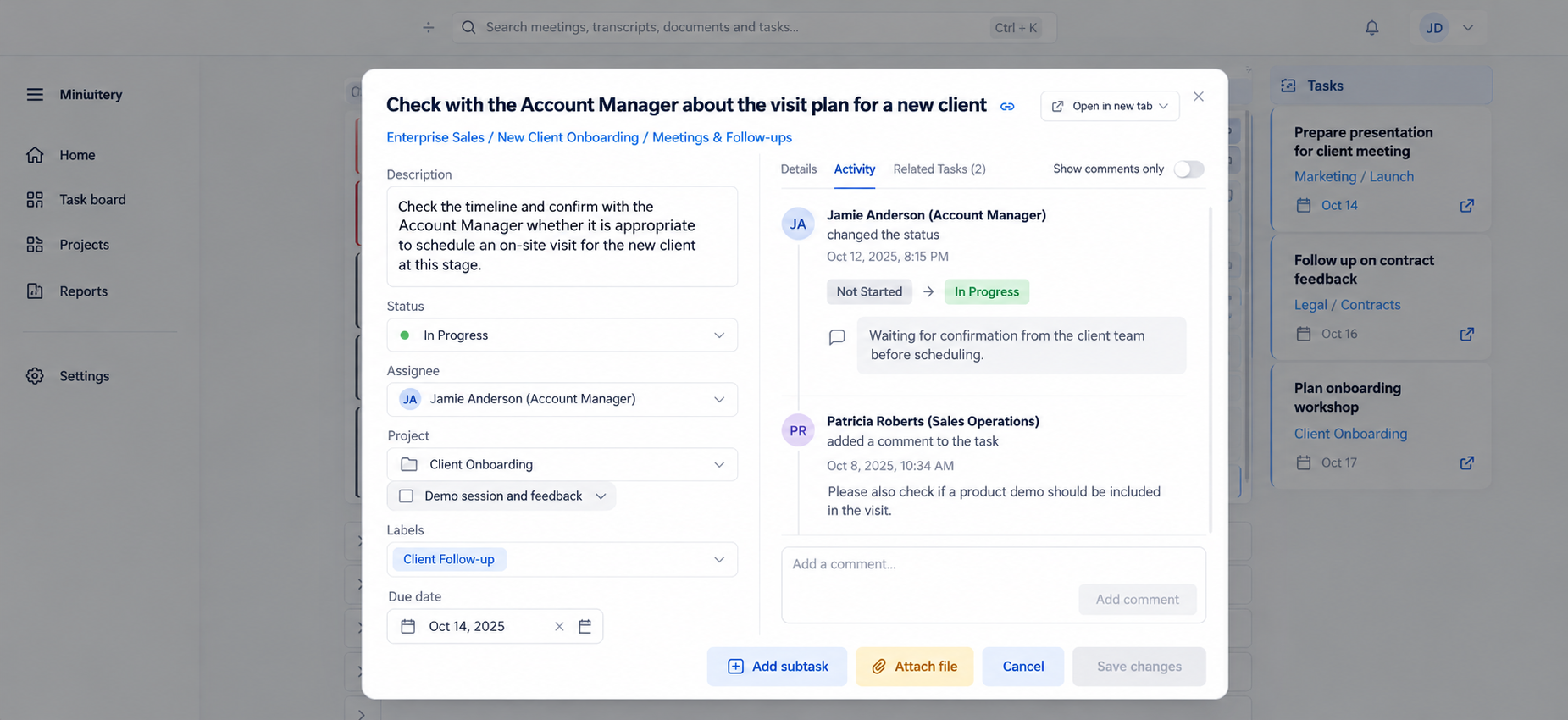
Underneath that pattern view sits the accountability layer. Minuteory pulls the commitments out of each meeting and gives each one an owner using RACI. For every action item it identifies who is Responsible for doing the work and who is Accountable for the outcome, and it enforces the rule that matters most, which is that each task has exactly one Accountable owner. That single constraint is what breaks the everyone assumed someone had it failure. When exactly one name owns the outcome, there is no ambiguity left to hide in. The Accountable owner keeps the task current as it moves, and each task carries the meeting it came from, so the commitment stays connected to the moment it was made. If you want the mechanics of that in one place, we wrote separately about how RACI names one accountable owner for every action item.
On top of that accountability layer, Minuteory scores the meeting itself across six dimensions: Purpose Clarity, Participant Engagement, Outcome Orientation, Personal Performance Suggestions, Meeting Analytics, and Overall Assessment. These are not vanity numbers. Purpose Clarity asks whether the meeting needed to happen and had a real agenda. Outcome Orientation asks whether it produced concrete next steps rather than a warm feeling. Personal Performance includes a RACI role assessment, so a person can see whether they are quietly becoming a bottleneck by holding too many roles at once. Together these dimensions are how to measure whether your meetings are working without sending a survey, from the room level all the way down to per meeting participation and engagement scoring.
And because a working memory of your meetings is only useful if you trust where your meeting data lives, the default AI processing runs inside the European Union, with a European hosted alternative available for teams that need stricter data residency. The interface is available in the working languages of Central and Southeastern European teams rather than English alone. None of this is the point on its own. It is what lets the accountability layer be something a regulated or multilingual team can actually adopt.
The through line is simple. Every feature exists to answer the two questions that started this, which are not what was said in any one meeting, but how this team meets over time and who owns what came out of it, tracked until it is done.
A Test You Can Run This Week
Here is a way to find out whether your team has meeting intelligence or just meeting notes. Pick one meeting that recurs, a weekly sync or a standing project review, and open the record of its last month rather than a single session.
First, try to read the pattern from the record alone. Across that month, can you say who carried the load, which topics kept coming back without ever closing, and whether the meeting is getting better or quietly decaying. Then, for each action item the series produced, answer two more questions. Can you name the one person who is accountable for it, not the group, not the project, one person. And can you show, without asking anyone, whether it has actually been completed.
If you can read the pattern and answer both ownership questions for every item, you have meeting intelligence, whatever tool produced it. If you can see the individual meetings but not the pattern across them, or you can name owners but not prove completion, you have a record rather than intelligence. If you cannot reliably do any of it, then what you have is a very good recording of people agreeing to things, which is meeting notes wearing a more impressive name.
Most teams who run this honestly land in the second or third case. That is not a failure of discipline. It is the predictable result of tools that were built to capture the room and were never asked to carry the work out of it.
Common Questions About Meeting Intelligence
What is the difference between meeting intelligence and meeting notes. Meeting notes are the record of what was said. Meeting intelligence is the layer above that turns the record into owned, tracked outcomes: who committed, who is accountable, and whether it got done. Notes describe the conversation. Meeting intelligence acts on it.
How often should teams review meeting patterns. For a meeting that recurs, a monthly look at the whole series is usually enough to catch a trend before it hardens, since a single session rarely tells you whether things are improving or slipping. The point is to read the group rather than react to one meeting, so pick a cadence that lets a pattern show up, review the thread as a whole, and act on what keeps recurring rather than on whatever felt loudest in the last call.
What is a RACI meeting. It is a meeting whose action items are assigned using the RACI framework, so each task has someone Responsible for the work and exactly one person Accountable for the outcome, along with anyone who needs to be Consulted or kept Informed. The value is the single accountable owner per task, which is what stops a commitment from quietly belonging to no one.
How does software extract action items from a meeting. It processes the transcript of the conversation, identifies the moments where a commitment was made, and turns each one into a task with a named owner and a link back to the meeting it came from. The quality of that extraction is what separates a real accountability layer from a summary that merely mentions that tasks exist.
See Your Meetings as Intelligence, Not Just a Record
If you ran the test above and did not like the answer, the fix is not more recording. It is adding the accountability layer that turns every meeting into owned, tracked work, so the question of who owns what and whether it got done has an answer you can see rather than a conversation you have to reopen. That is the whole reason Minuteory exists, and you can start turning your own meetings into meeting intelligence today at app.minuteory.com.