GDPR Compliant Meeting Notes with EU Data Residency
Last month a prospect stopped me in the middle of a demo. She ran operations for a company that handles patient records, and she was not interested in the summary I was showing her. She wanted to know one thing. Once her team uploaded a recording, where did it physically go, and could she prove it to her own auditor. I started to answer, and then I slowed down, because the honest answer to that question is longer than most tools ever give.
That conversation stayed with me. She was not asking whether the notes were good. She assumed that. She was asking who could reach the audio, which country the servers sat in, and what she could show a regulator if one ever asked. For her, a beautiful summary sitting on infrastructure she could not describe was not an asset. It was a liability she would have to answer for.
I have had a version of that conversation many times since. The people who ask it are rarely the loudest voices in the room. They are the ones who sign off on the tool, or quietly refuse to.

Where your meeting notes live is a question you will be asked
Every meeting your team records becomes a small archive of who said what. Names, a salary mentioned in passing, client details, a candid line about a customer. Once that lives inside an AI tool, someone in your company becomes responsible for it, whether they realise it or not. The first time a client, an auditor, or a nervous head of legal asks where the data sits, that responsibility arrives all at once.
Most teams do not think about this until the question lands. They pick a meeting tool for the transcript quality and the price. Then a deal with a larger customer stalls on a security review, or a new hire in a regulated role declines to use a tool that cannot tell them where recordings are stored. The value of the notes has not changed. What changed is that someone finally asked the question my prospect asked me, and the answer was a shrug.
Why storing data in the EU is not the same as EU data residency you can prove
A lot of tools now say they are GDPR compliant, and many will tell you they store data in Europe. That sentence is easy to write on a pricing page. The harder part is what sits underneath it. Where does the audio go while it is being processed. Which provider runs the model that reads it. Is there an agreement you can actually sign that names these things, or just a badge in the footer.
This is where the gap opens. Secure meeting notes in the EU are not only about a storage region. They are about being able to describe the whole path a recording takes, from upload to summary, and to hand someone a document that commits to it. Meeting AI data privacy is a chain, and a chain is only as honest as its weakest link. A tool that keeps the final transcript in European servers but sends the audio somewhere else to be processed has not given you EU data residency. It has given you a sentence.
When my prospect asked her question, she was really testing whether I understood that difference. Telling her the notes were compliant would have ended the conversation. Being able to walk the path is what kept it going.
What EU data residency meeting notes look like inside Minuteory
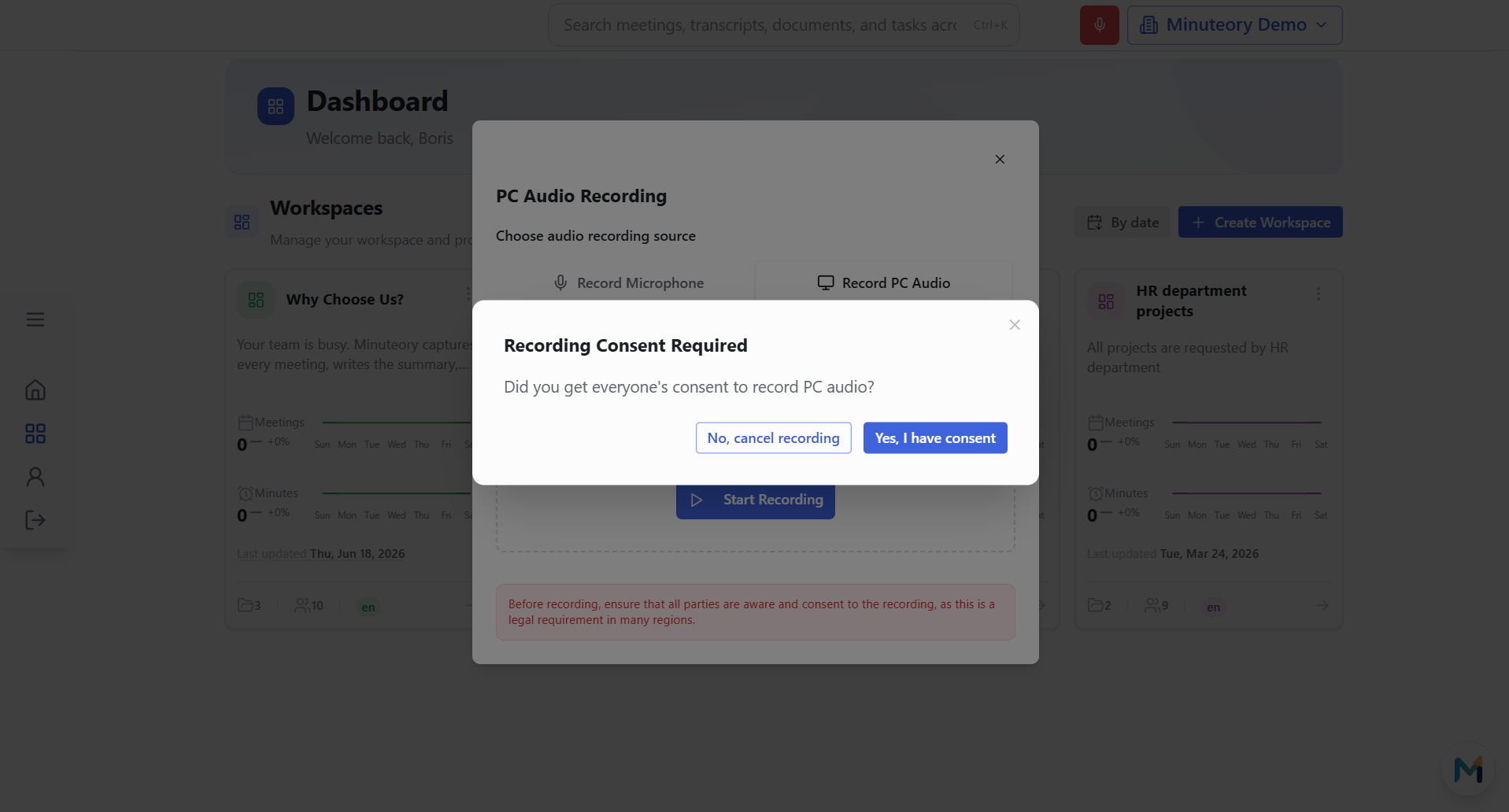
I built Minuteory for the person who has to answer that question, not the person who never asks it. So EU data residency meeting notes are not a marketing line here. The default processing runs inside the EU on Google Vertex AI, in European regions, and if your requirements are stricter than that, you can request a European hosted alternative through our engineering team rather than being told the standard setup is all there is. Before your team can even create an organisation, they accept a Data Processing Agreement, so the commitment is written down and signed, not implied. You can point an auditor at our EU data processing agreement and at how Minuteory handles meeting data instead of promising to go and find out.
There is something I learned from these conversations that changed how I describe the product. The people who care where the data lives usually care just as much about who is in the room when the data is created. That is the part most tools ignore.
Recording without a bot in the call
When a recording tool sends a bot to sit in your meeting, that bot is a participant. It shows up, it is visible, and on some platforms the host now has to wave it past a security prompt before it can join. For a call about a customer or a candidate, an extra attendee that belongs to a software vendor is exactly the thing a privacy minded buyer does not want.
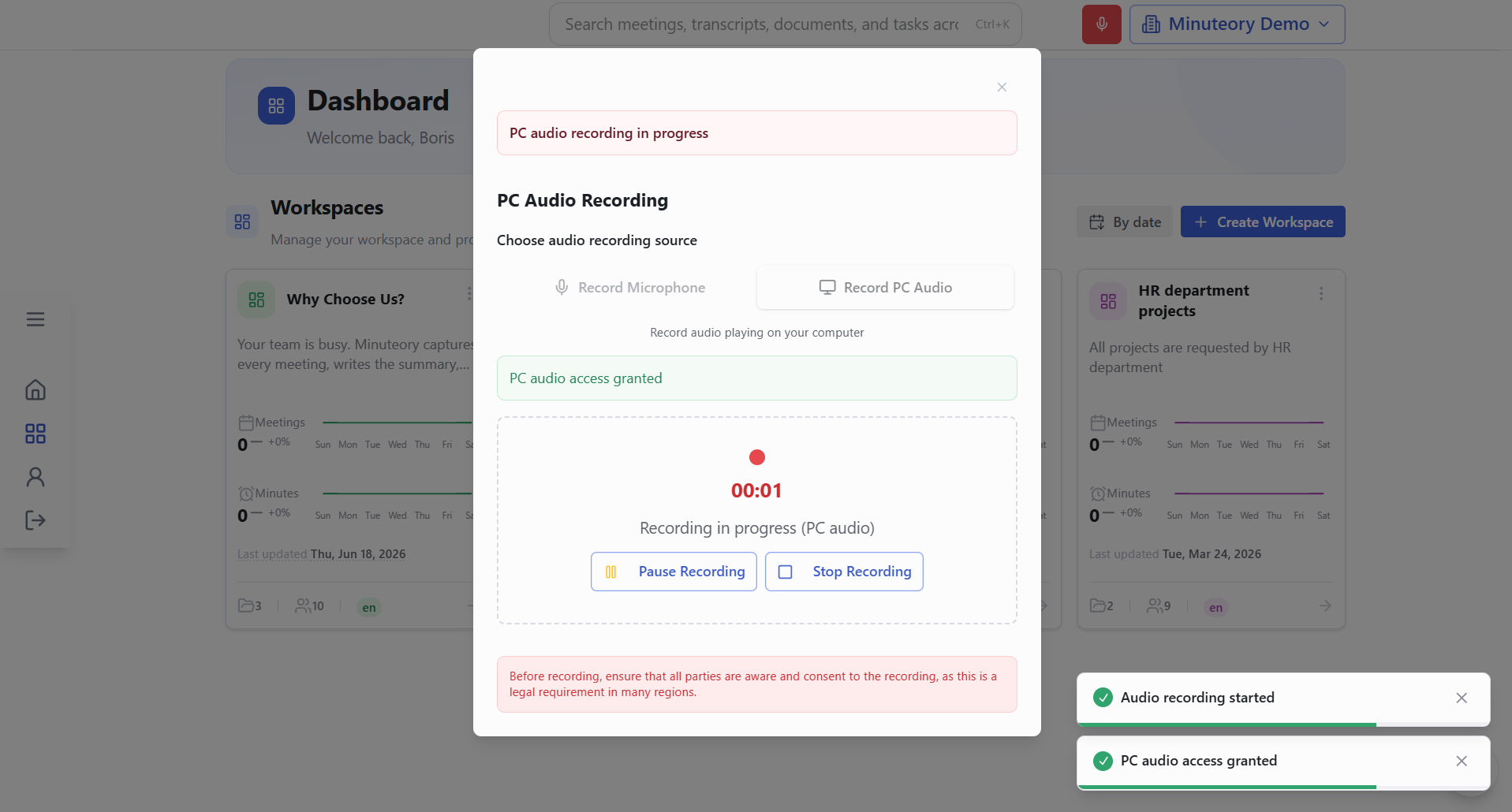
Minuteory does not do that. You bring the recording to Minuteory rather than sending Minuteory into the meeting. You upload the audio or video file after the call, or you pick a recording straight from your connected Google Drive, and the transcript and summary are generated from there. No bot meeting notes for Google Meet means there is no vendor attendee in the room and nothing for a host to approve. Being an AI meeting notetaker without a bot is not a smaller version of the feature. For the buyer who asked me where the data lives, it is the same instinct expressed twice. Keep the meeting private, and keep control of the record afterward. If you want the longer version of what your meeting AI does with your data after the call, we walked through it in a separate piece.
Because the whole point of Minuteory is what happens after the meeting, that record is not just a transcript. Tasks are extracted with named owners under a RACI structure, so accountability is assigned rather than left buried in the notes. Each meeting is scored across the six analytics dimensions, Purpose Clarity, Participant Engagement, Outcome Orientation, Personal Performance, Meeting Analytics, and Overall Assessment. All of it sits inside a multi organisation structure built for teams that keep their client work separate. The data stays in the EU, no bot joins the call, and the meeting still turns into decisions and owners. That combination is the answer I could not give in one sentence on that demo.
A test you can run this week
Here is the exercise I now suggest to anyone weighing a meeting tool. Open the tool you use today and try to answer three questions without contacting support. Which country is the audio processed in, not just stored in. Is there a signed agreement that names it, or only a claim. And when you record, does anything join the call that does not belong to your company. If you can answer all three in a minute, you have a tool you can defend in a security review. If you cannot, you have just found the exact question a customer or an auditor will eventually ask you, before they ask it.
Where your meeting data should live
Your meeting notes are only an asset for as long as you can stand behind where they live and who made them. If you want to see what meeting notes look like when EU data residency and a recording process with no bot in the call are the starting point rather than an upsell, you can try it with your own meeting at app.minuteory.com.