
How to Measure Meeting Effectiveness (Without Surveys)
Eight months into a weekly recurring meeting, I started to suspect it was the wrong shape for the problem it was supposed to solve. Not because anyone said so. The meeting still ended on time. People still nodded and closed their laptops sure the thing had been handled. But the decisions it produced had changed. In the first few months the meeting moved things. By month eight it was mostly confirming conversations that had already happened in smaller groups. I could feel the difference and I could not measure it.
I asked two of the people who attended regularly whether they thought the meeting was still useful. Both said yes. Neither said it with much energy. I sent a short survey to the full group. Most people filled it in. Most of the responses said the meeting was good or very good. None of that was useful to me. What I wanted to know was not whether people liked the meeting. I wanted to know which part had stopped working and why.
That is the gap this post is about. Sensing that a meeting underperforms is not the same as knowing where it fails. One is a feeling in the room. The other is information you can act on.

The problem with how most teams measure meeting effectiveness today
The standard tools for this are surveys and headcounts. After a meeting someone sends a form. Did you find this useful. Was the agenda clear. Were the right people present. The answers come back vague or politely positive, because very few people are willing to write down that a meeting wasted their afternoon. What you end up with is a record of how people say they felt, filtered through courtesy, not a record of what the meeting actually produced.
The other proxy is attendance. If people show up the meeting must be working. If they drift away it must not be. Neither inference holds. People sit through meetings they find useless because missing them is worse. People skip meetings that matter because something more urgent landed that morning. The signal most leaders never track is not whether people attended or said they were satisfied. It is whether the session produced a measurable output, in the form of decisions with named owners and clarity on what happens next.
Why the standard ways to measure meeting effectiveness fall short
A good meeting has a purpose everyone understands before it starts. The right people are present. Each person contributes in proportion to their role. The conversation produces decisions with named owners. The whole thing is worth the sum of the time the attendees spent on it. Most teams could recite that list. What they do not have is a way to score each of those components after a meeting ends and before the next one starts.
The information needed to score them already exists. It sits in the transcript, the agenda, the speaking patterns, the action items, and the decisions. Pulling a quality signal out of all that is a full analysis job, and nobody does it by hand. So the meeting runs again the following week in the same shape, and the parts that were not working last time carry on not working. Note taking does not close this gap. Capturing what was said is now a commodity, available inside the tools most teams already run on. The uncontested ground is measuring whether the meeting worked, and that is where the rest of this post sits.
How to measure meeting effectiveness with AI scoring
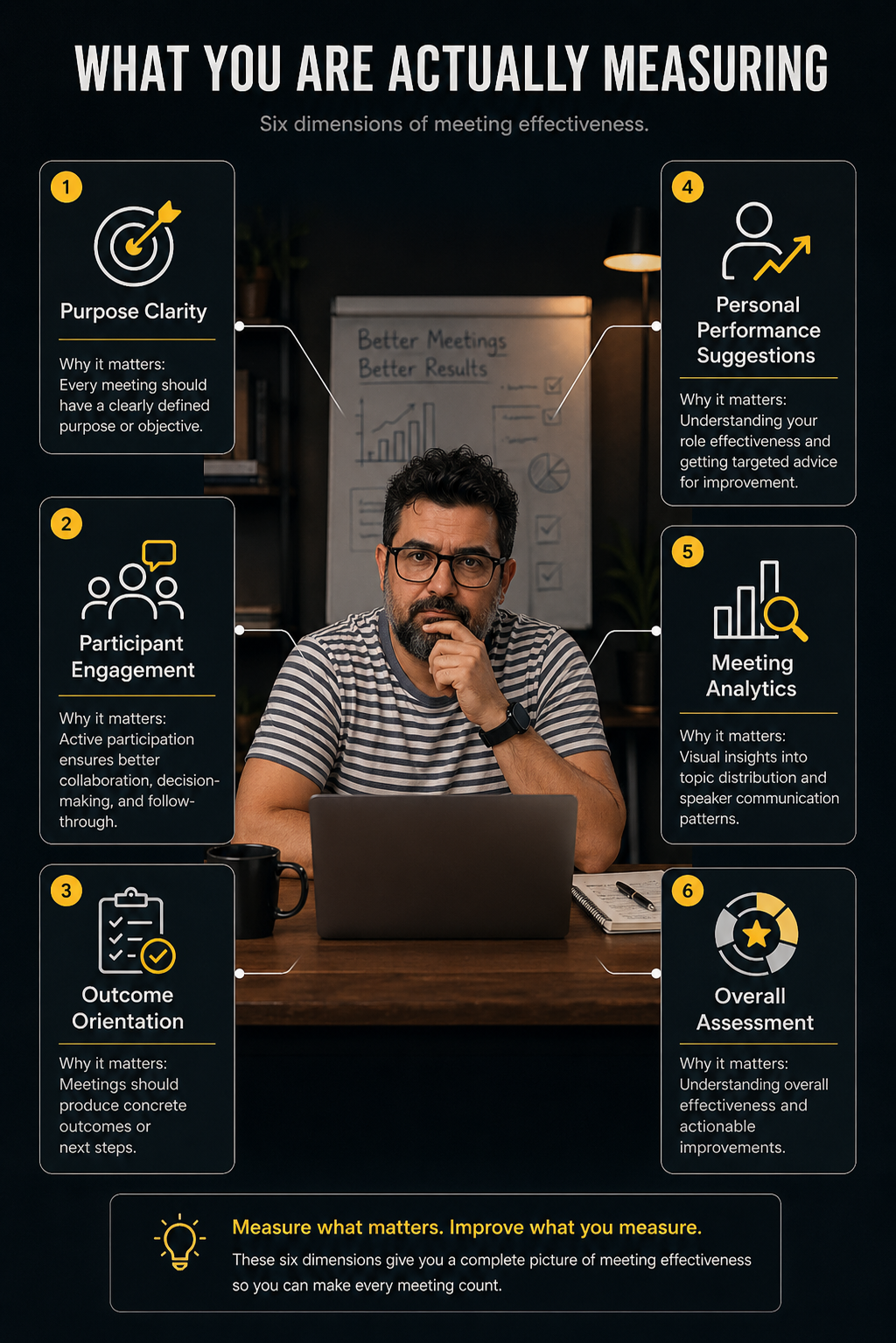
Minuteory scores every meeting across six dimensions drawn straight from the transcript. For a standard meeting you set nothing up and you ask no one to complete anything afterward. When the transcript is ready, the analytics are generated alongside it. The score is not a satisfaction rating. It is an assessment of the meeting itself across six specific components of quality.
The six dimensions are Purpose Clarity, Participant Engagement, Outcome Orientation, Personal Performance, Meeting Analytics, and Overall Assessment. Purpose Clarity evaluates whether the meeting had a defined objective and whether participants understood what they were there to accomplish. Participant Engagement looks at whether the right people were in the room, whether all voices were heard, and whether the discussion was structured. Outcome Orientation assesses whether the meeting produced concrete decisions and whether each action item had a named owner with clear criteria for completion. Personal Performance goes one level further, evaluating how well each participant played their role and generating specific improvement advice for that person based on how they contributed during this meeting. Meeting Analytics surfaces topic distribution and a per speaker communication assessment from the session. Overall Assessment synthesises all of it into a meeting effectiveness rating out of ten with specific recommendations for the next session. None of it asks anyone to fill in a thing. The signal comes from the meeting itself.
How to measure meeting effectiveness with an AI meeting quality score
Six separate readings roll up into a single meeting quality score, and that number is what most people are after when they go looking for meeting effectiveness metrics or a meeting performance tracking tool. The difference here is where the score comes from. A survey based number measures sentiment. An AI meeting quality score measures the meeting. Because the scoring framework is configurable per meeting type, a sales review and an internal retrospective can each be judged against the criteria that actually matter for that kind of session, rather than one generic template. That is the part the survey approach cannot reach, a consistent and repeatable measure of quality that does not depend on anyone remembering to rate anything.
What the six scoring dimensions reveal about a recurring meeting
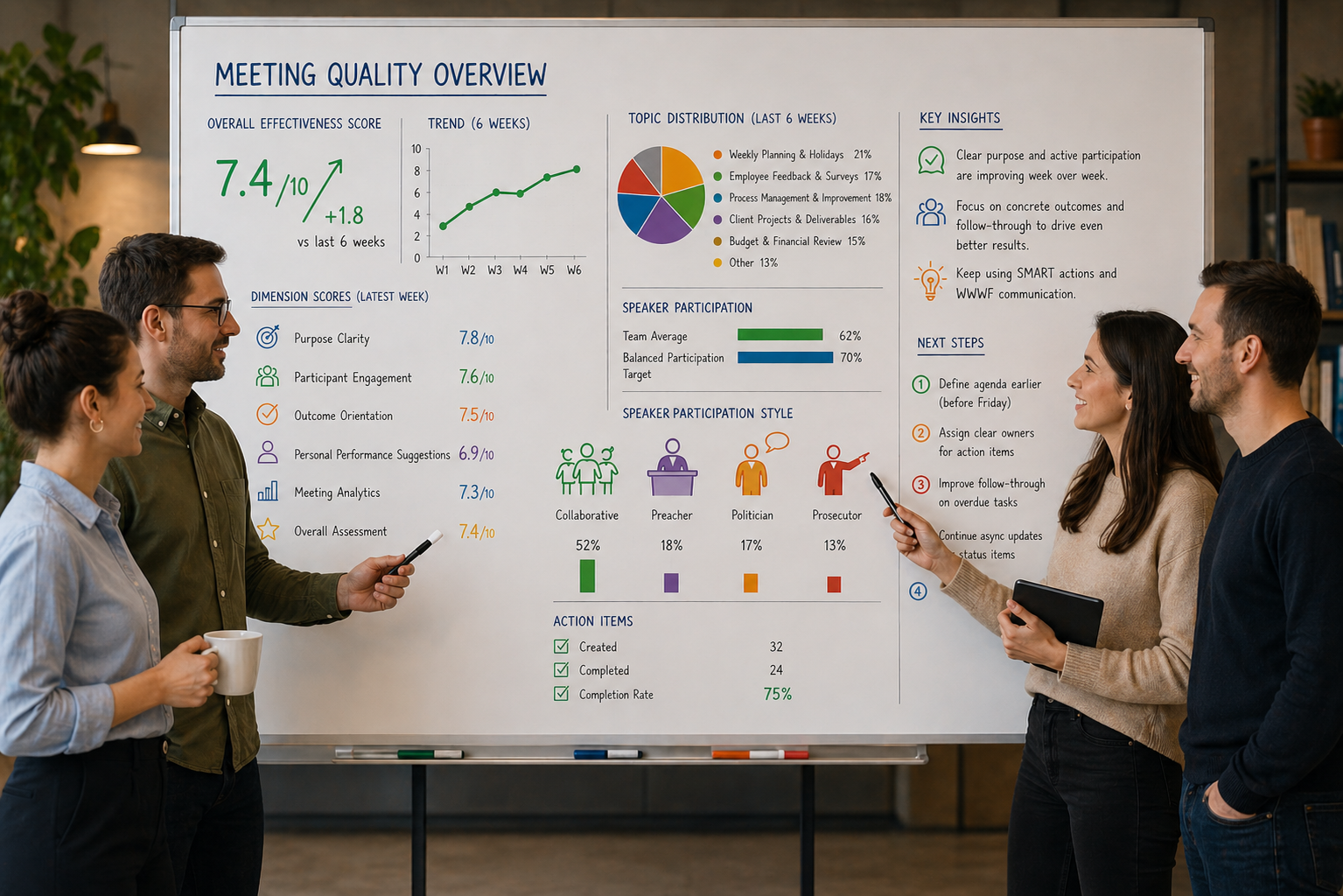
The reason six dimensions beat a single number is that they point at different problems. A meeting with a low Purpose Clarity score and a high Participant Engagement score is one where people took part actively but were not sure why they were there. That is a preparation problem, not a people problem. A meeting with a high Outcome Orientation score and a low Participant Engagement score produced decisions but concentrated them in one or two voices. That is a facilitation problem.
A recurring meeting is best read as a connected series rather than a set of isolated sessions. When you keep the same recurring meeting together as a thread, the movement in the six dimensions from one session to the next becomes the real diagnostic. A dimension that slips while the others hold tells you exactly where to intervene before you run the same meeting again. Those distinctions never come out of a form that asks people to rate the session from one to five. They come from scoring the components separately and watching the pattern.
If you want to see how speaking time and topic distribution sit underneath these scores, that is covered in a companion piece on what your meeting AI does after the summary.
A test you can run on your next recurring meeting
Pick one recurring meeting you have run at least four times in the last two months. After the next session ends, let the scoring run. Look at the six dimensions individually before you look at the Overall Assessment. Find the lowest scoring dimension. Then ask yourself whether you already knew that dimension was the problem, or whether it was invisible to you until the score surfaced it.
That gap between what you sensed and what the score shows is the exact thing a survey would have missed. Most recurring meetings are not broken in a way anyone planned. They drift. A meeting that fit one context gets carried into a new one where it no longer belongs. The agenda stays the same because nobody questioned it. The invite stays the same because nobody updated it. The score moves before anyone says a word out loud. If you are already running the meeting, that score is available now.
Where measurement becomes improvement
Meeting notes tell you what was said. A meeting effectiveness score tells you whether the meeting worked. If you want to see what measuring meeting effectiveness looks like when the assessment comes from the transcript instead of from a survey, run it against your own next recurring meeting at app.minuteory.com.